Not sure the Chinese taxpayer is footing the bill though - of course, it might not be net zero, there might be secondary effects, etc.
A few days ago I read an article saying the Chinese utilities have a pricing structure that favors high-tech industries (say, an AI data center), making the difference by charging more the energy-intensive but less sophisticated industries (an aluminium smelter, for example).
Admittedly, there are some advantages when you do central and long-term economic planning.
For internal use like that you can also use the library feature. The downside of using long=31 is increased memory usage, which might not be desirable for customer facing applications like Steam.
There’s a current product that does simple mechanical remodeling: sleep with this chunky contact lens in and the next morning you see better. But it wears off in ten hours or less.
Night lenses! Yeah they're pretty crazy (I'm in the process of getting them and a friend of mine has them). 10 hours is low though - they're supposed to easily make your vision last all day, even two. My friend says he only really stops seeing well after 3 nights of not wearing them.
I tried them and they were awful for me. Didn't last the full day, caused terrible halos while driving (and that was BEFORE 90% of cars drove with LED high beams), were generally too uncomfortable.
Same results for me. Absolutely awful, vision consistently began failing by becoming noticeably blurry about 8 to 9 hours after taking night lenses out, and I couldn't drive at night because of headlight and streetlight halos even after "topping off" with those uncomfortable lenses during the day. As an enthusiastic night sky observer, trying to use those lenses was depressing.
I gave up after extended tries with three different lenses (I think it was six to nine months total), with my highly experienced doctor consulting with different manufacturers and researchers from around the country. Turns out my pupils naturally open up too wide, made worse by corneas that apparently are not thick enough to retain the reshaping all day. These issues, incidentally, make me ineligible for the popular cut-n-burn style of eye surgery.
On the bright side, it was indeed completely reversible and I've suffered no effects of any kind after about two days of non-use. That was a bit over a decade ago.
I think Canada has it with Novamin, while the US doesn't. The Netherlands does, and Germany doesn't. All with the same "repair & protect" name. It's puzzling. Now Germany does have it under a new "clinical repair" name, of course the "clinical" ones in the US do not, those do contain soap for some reason (sodium lauryl sulfate) which I don't think I've seen in any other country.
That's still not much for wiring in most countries. A small IKEA consumer oven is only 230V16A=3860W. Those GPUs and CPUs only consume that much at max usage anyway. And those CPUs are uninteresting for consumers, you only need a few Watts for a single good core, like a Mac Mini has.
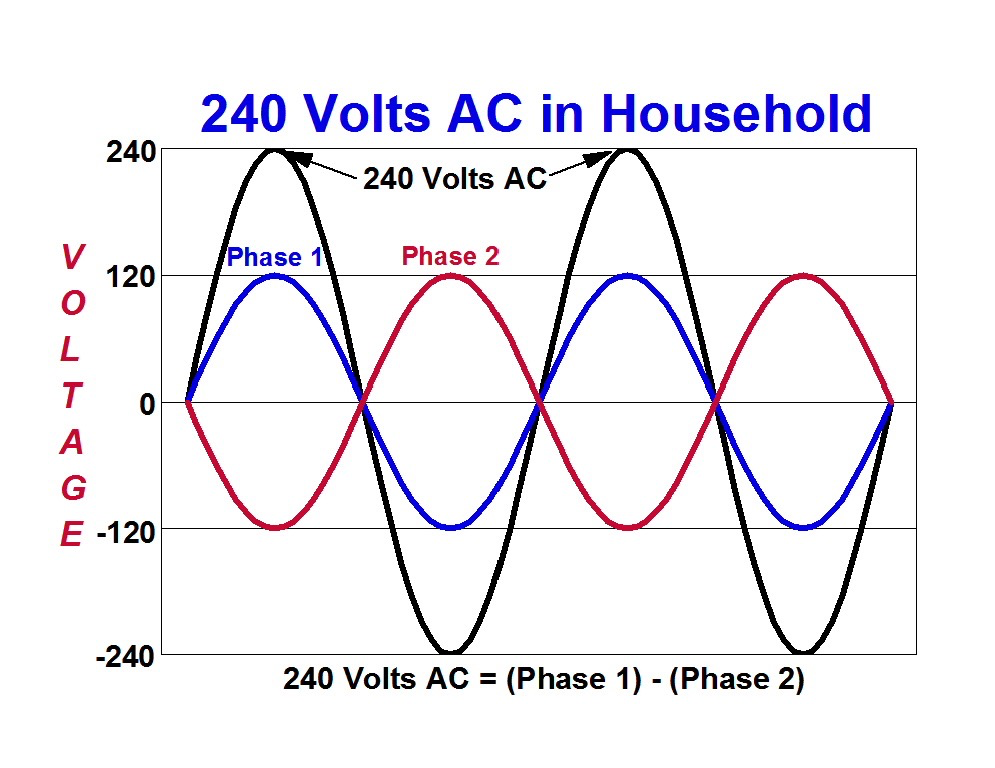
All American households get mains power at 240v (I'm missing some nuance here about poles and phases, so the electrical people can correct my terminology).
It's often used for things like ACs, Clothes Dryers, Stoves, EV Chargers.
So it's pretty simple for a certified electrician to just make a 240v outlet if needed. It's just not the default that comes out of a wall.
To get technical -- US homes get two phases of 120v that are 180 degrees out of phase with the neutral. Using either phase and the neutral gives you 120v. Using the two out of phase 120v phases together gives you a difference of 240v.
Yeah that's right. The grid is three phases (as it is basically everywhere in the world), and the transformer at the pole splits one of those in half. Although, what are technically half-phases are usually just called "phases" when they're inside of a home.
> So it's pretty simple for a certified electrician to just make a 240v outlet if needed. It's just not the default that comes out of a wall.
It'd be all new wire run (120 is split at the panel, we aren't running 240v all over the house) and currently electricians are at a premium so it'd likely end up costing a thousand+ to run that if you're using an electrician, more if there's not clear access from an attic/basement/crawlspace.
Though I think it's unlikely we'll see an actual need for it at home, I imaging a 800w cpu is going to be for server class CPUs and rare-ish to see in home environments.
I kinda suspect there’s a premium once you mention “EV vehicle”, since you’re signalling that you’re affluent enough to afford an EV and have committed to spending the money required to get EV charging at home working, etc. (Kinda like getting a quote for anything wedding related.)
I’m getting some wiring run about the same distance (to my attic, fished up a wall, with moderately poor access) for non-EV purposes next week and the quote was a few hundred dollars.
the trick is to request 240v outlet for welder. it brings price down to 400 or so.
running to another room will be done usually (at least in usa) through attic or crawlspace. i got it done a few months ago to have dedicated 20A circuit (for my rack) in my work room. cost was around 300-400 as well
Labor chargers alone are going to be higher than that in Seattle. Just to have someone come out on a call is going to be 150-200. If it is an independent electrician who owns their own business, maybe 100-150/hr, if they are part of a larger company, I'd expect even more than that.
Honestly I wouldn't expect to pay less than $1000 for the job w/o any markups.
Handy man prices around here are $65 to $100/hr, and there is a huge wait list for the good ones.
I've gotten multiple quotes on running the 240v line, the labor breakdown was always over $400 alone. Just having someone show up to do a job is going to be almost $200 before any work is done.
When I got quotes from unlicensed people, those came in around $1000 even.
in bayarea subreddits there are multiple posts talking about EV charger vs welder outlet and how it drops price from 2000 to 500 or so (depends on complexity).
another thing, which is good long term is to a find a local electrician (plumber, etc) who doesn't charge service calls and have reasonable pricing.
no idea about handyman pricing. never used any. for electrical/water/roofing i prefer somebody who is licensed/insured/bonded/etc
I should look at the label (or check with a meter..), but when I run my SGI Octane with its additional XIO SCSI board in active use, the little "office" room gets very hot indeed.
If we're counting all the phases then european homes get 400V 3-phase, not 240V split-phase.
Not that typical residential connections matter to highend servers.
Well yes its possible but often $500-1000 to run a new 240v outlet, and that's to a garage for an ev charger. If you want an outlet in the house I dont know how much wall people want to tear up and extra time and cost.
In the Nordics we're on 10A for standard wall outlets so we're stuck on 2300W without rewiring (or verifying wiring) to 2.5mm2.
We rarely use 16A but it exists. All buildings are connected to three phases so we can get the real juice when needed (apartments are often single phase).
I'm confident personal computers won't reach 2300W anytime soon though
In Italy we also have 10A and 16A (single phase). In practice however almost all wires running in the walls are 2.5 mm^2, so that you can use them for either one 16A plug or two adjacent 10A plugs.
In the Nordics (I'm assuming you mean Nordic countries) 10A is _not_ standard. Used to be, some forty years ago. Since then 16A is standard. My house has a few 10A leftovers from when the house was built, and after the change to TN which happened a couple of decades ago, and with new "modern" breakers, a single microwave oven on a 10A circuit is enough to trip the breaker (when the microwave pulses). Had to get the breakers changed to slow ones, but even those can get tripped by a microwave oven if there's something else (say, a kettle) on the same circuit.
16A is fine, for most things. 10A used to be kind of ok, with the old IT net and old-style fuses. Nowadays anything under 16A is useless for actual appliances. For the rest it's either 25A and a different plug, or 400V.
I think it is common. In that religion heaven is in the clouds above, and someone going very high up into the clouds but not reaching it then got closer than others did.