I still think graffiti is cool, but my enthusiasm has waned as I've aged.
Not a chance I'm going to read this insanely long essay.
As I grew up I read Subway Art, Spraycan Art and watched Style Wars. Played Jet Set Radio and Marc Ecko's Getting Up. As well as watching whatever AEROHOLiCS releases I could find uploaded to P2P sites.
I would photograph the graffiti whenever I went on a holiday and took SLR photos in my city.
I still get excited when I see bombed cargo trains on my commute to $DAYJOB. But sadly that rush of excitement is gone.
Sadly the name is junk so I doubt it will ever take off outside of technical circles, which will ensure its irrelevance. I think Brave did a decent job of naming their browser.
> I'd characterise Americans as less pretentious and more straight talking.
Various registers representing a huge proportion of US English we see and hear day-to-day are terrible. American “Business English” is notably bad, and is marked by this sort of fake-fancy language. The dialect our cops use is perhaps even worse, but at least most of us don’t have to read or hear it as much as the business variety.
> The dialect our cops use is perhaps even worse, but at least most of us don’t have to read or hear it as much as the business variety.
Ugh, and journalists often slip into cop dialect in their articles. It's disgustingly propagandic.
Notice that cops never kill or shoot someone, even in situations where they're blatantly in the wrong. It's always, "service weapon was discharged" or "subject was fired upon." Make sure to throw a couple "proceeded to's" in there for good measure.
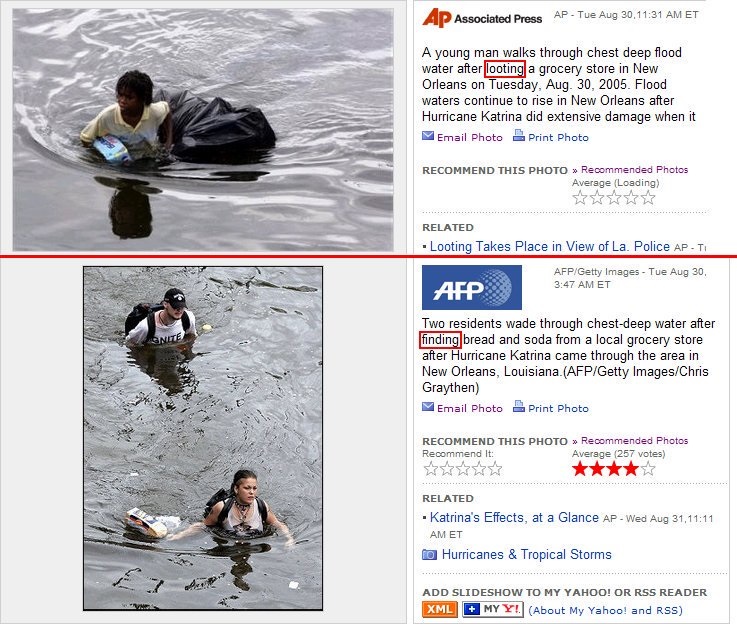
2005 Hurricane Katrina, news described a black man carrying bread through floodwater as "looting a grocery store" and white people carrying bread through floodwater as "finding bread and soda from a local grocery store".
someone starts using business english and my bullshit meter pegs.
my significant other loves the "real life mormon housewives" and "lovingly blind" reality shows, and when they use business english (a weird thing to do when talking about relationships, but hey, what do I know I'm an engineer) it's a tell that they're lying.
I recently had a terrible experience with a developer who only communicates this way, and it's terrible.
Every single sentence is way too complicated, vague, deferring, or hand-wavy, and I can't know if they're being honest or just bullshitting me.
Half of the terms are incorrectly or are exaggerations when I probe: "Coupled" means "the code is confusing to me". "Monolith" means "the architecture is complicated to me". "Refactoring" means "adjusting the style". "We need a new abstraction" means "we need a new idea".
The team already had some issues with misunderstandings because of the above.
It's someone so eager to be part of the "big boys club" and trying to push their way to the top.
I think it has much more to do with porting the vernacular vs. formal register distinction common in other languages into english than how english people actually used to speak and write.
Maybe so, but it was my time at a British university in the late-nineties that taught me how to write simply and precisely. Maybe I'd been infected (as described in sibling comments) with American "Business English"?
It's most likely that they are. As farfetched as this sounds, the CIA and the Iowa Writers' Workshop influenced American writing a great deal, encouraging writing to be taught in the "American" / Hemingway style.
> “the American MFA system, spearheaded by the infamous Iowa Writers’ Workshop” as a “content farm” first designed to optimize for “the spread of anti-Communist propaganda through highbrow literature.” Its algorithm: “More Hemingway, less Dos Passos.”
"There is no America. There is no democracy. There is only IBM, and ITT, and AT&T, and DuPont, Dow, Union Carbide, and Exxon. Those are the nations of the world today. What do you think the Russians talk about in their councils of state, Karl Marx? They get out their linear programming charts, statistical decision theories, minimax solutions, and compute the price-cost probabilities of their transactions and investments, just like we do. We no longer live in a world of nations and ideologies, Mr. Beale. The world is a college of corporations, inexorably determined by the immutable bylaws of business. The world is a business, Mr. Beale. It has been since man crawled out of the slime."


Not a chance I'm going to read this insanely long essay.
As I grew up I read Subway Art, Spraycan Art and watched Style Wars. Played Jet Set Radio and Marc Ecko's Getting Up. As well as watching whatever AEROHOLiCS releases I could find uploaded to P2P sites.
I would photograph the graffiti whenever I went on a holiday and took SLR photos in my city.
I still get excited when I see bombed cargo trains on my commute to $DAYJOB. But sadly that rush of excitement is gone.
reply