In my experience, humans respond incredibly poorly to traffic lights being out. There's no sense or reason, just people deciding to drive across the intersection when they feel like it's okay.
Presumably Waymo will make sure they can handle this situation in the future, but I'm not sure there's a really satisfactory solution. The way you're supposed to handle an intersection with no lights (treat it as a stop sign intersection) doesn't work very well when no one else is behaving that way.
That wasn’t my experience, having just driven across the city and back during tonight’s outage. It was actually weirdly inspiring how well people coordinated at so many of the powerless intersections.
There was a lot of confusion, and some people took advantage of it to rush through, but for the most part it was pretty orderly. Which makes sense because in many parts of the world where there are no traffic lights or stop signs, people get on just fine.
The Waymo’s, on the other hand, were dropping like flies. While walking from Lower to Upper Haight I spotted a broken Waymo every handful of blocks. The corner of Haight & Fillmore was particularly bad, with 3 of them blocking traffic in both directions — in the path of both the 7 and 22 bus lines.
I think a significant factor helping that to work is the mixing of all traffic on the street. I've noticed that in LA's Skid Row, where homeless people are constantly moving into the street on foot or on bicycle and they walk around in vehicle lanes pushing shopping cart armadas and so on, drivers are more cautious than usual and I see, if anything, less reckless driving and close calls there than in other parts of downtown, where pedestrians stick to the sidewalk and distracted or car-brained drivers don't look out for them. Just anecdotal observation, of course.
Different things. A country with lax rules is not the same as a specific environment with shared spaces, where according to known data it's safer to eliminate some specific kind of regulation and let the remaining part take over.
There have been some experiments that suggest that traffic flow is both safer and more efficient if you just turn disable the signals entirely. I doubt it applies to all, or even most, situations but it's definitely food for thought: https://www.npr.org/2008/01/19/18217318/german-towns-traffic...
My own experience has given me a somewhat more-nuanced take.
At first, it's akin to the path of evil. Way too many people just zoom through intersections with dark traffic lights like they're cruising unimpeded down the Interstate, obvious to their surroundings. Some people get grumpy and lay on the horn as if to motivate those in front of them to fly through themselves.
But many people do stop, observe, and proceed when it is both appropriate and safe.
After awhile, it calms down substantially. The local municipality rounds up enough stop signs to plant in the middle of the intersections that people seem to actually be learning what to do (as unlikely as that sounds).
By day 2 or 3, it's still somewhat chaotic -- but it seems "safe" in that the majority of the people understand what to do (it's just stop sign -- it may be a stop sign at an amazingly-complex intersection, but it's still just a stop sign) and the flyers are infrequent-enough to look out for.
By day 5 or 6, traffic flows more-or-less fine and it feels like the traffic lights were never necessary to begin with. People stop. They take turns. They use their turn signals like their lives depend on it. And the flyers apparently have flown off to somewhere else. It seems impossible to behold, but I've seen it.
But SF's outage seems likely to be a lot shorter than that timeline, and I definitely agree with Waymo taking the cautious route.
(but I also see reports that they just left these cars in the middle of the road. That's NFG.)
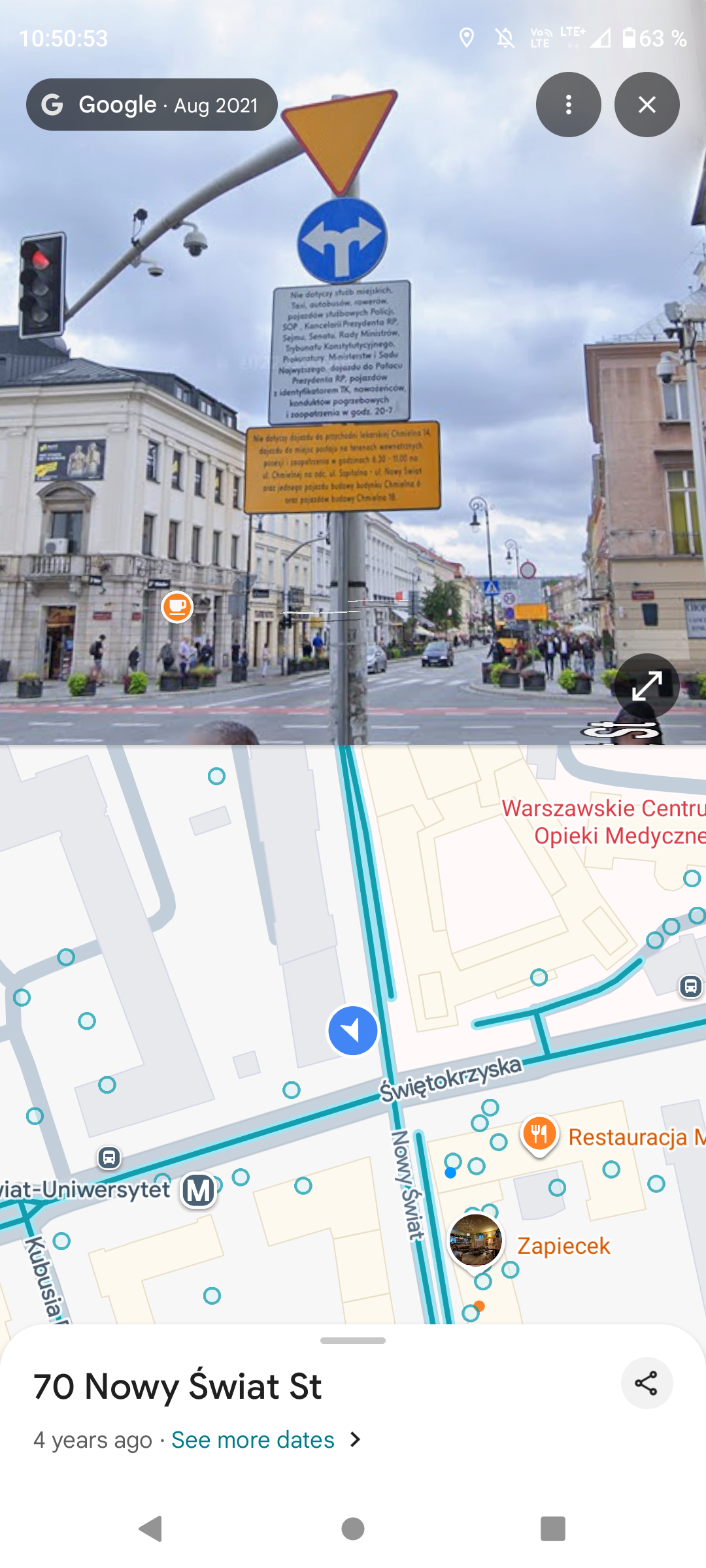
Huh, here in Germany we have street signs (mostly of a "you are the priority road" 45° rotated square yellow-on-white "sunny side up egg" sign and the "you are not the priority road" down-pointing white-on-red triangle; for 3-way if the priority road isn't the straight road or the concept of straight is ambiguous, there's a supplemental sign depicting the path of the priority road) permanently on traffic lights; it's also common enough for non-major roads to have the lights turned off at night so drivers tend to be familiar with falling back to the signs when the lights are off.
In absence of priority roads there is also the "right before left" rule which means that the car coming from the right if they would conflict in time is the car that has priority.
It's also always illegal to enter an intersection if you can't immediately clear it; that seems to work better when there are no green traffic lights to suggest an explicit allowance to drive, though.
Sure, but we're pretty far from Germany over here.
In the States (or at least, every US state that I'm familiar with -- each one is free to make their own traffic rules, similar to how each EU member state also has their own regulatory freedoms), a dark/disabled/non-working traffic light is to be treated as stop sign.
For all drivers, in all directions of travel: It functionally becomes a stop sign.
That doesn't mean that it is the best way, nor does it mean that it is the worst way. It simply is the way that it is.
How does "you can only piss with the cock you've got" translate to German slang?
I saw this recently when the lights were out at an intersection in Manhattan. People kept on driving and almost hitting pedestrians and cars. I called 911 and then directed traffic for 15 minutes until DoT came out and put up a temporary stop sign.
Odd that it was necessary, my mental model of manhattan is that it would become so slow and chaotic that it would be free reign for pedestrians to walk wherever
Driving up 6th Ave all the lights change in sync one after another, so that street kept moving. Unfortunately, cars kept moving even when the light would have been red and nearly hitting pedestrians and cross traffic.
Treating it like a stop sign also doesn't work very well when there are huge amounts of pedestrians. As a pedestrian that yesterday meant I got the right of way all the time. For cars it was mayhem downtown.
In contrast many years ago I lived at an intersection that had almost no pedestrians back then and a few times for a power outage limited to our building and that intersection. I enjoyed standing on my balcony and watch traffic. It mostly worked well. Cars did treat it like a intersection with stop signs. There two issues happened though. One was when there was no car already stopped and about 10%-20% of drivers didn't realize there was an intersection with lights out and just raced through it. The other ironically were bicyclists. 90% of the just totally ignored there was an intersection. That was especially scary when they arrived at the same time as one of those cars who didn't realize it either.
> Treating it like a stop sign also doesn't work very well when there are huge amounts of pedestrians. As a pedestrian that yesterday meant I got the right of way all the time. For cars it was mayhem downtown.
I’ve long been curious if people in S.F. who are used to Waymo “behavior” – including myself – behave differently when a Waymo is involved. For the most part, Waymos are extremely predictable and if you’re on the road as a pedestrian, cyclist, or car, are you more aggressive and willing to assert your turn in the road? Curious if Waymo has done a psychological study of how we start to think about the vehicles. I know many runners, for example, that’ll stride right into the crosswalk in front of a Waymo but wouldn’t dare to do that in front of other cars. Similarly, anecdotally people treat public transit vehicles differently than a civilian car: folks are more willing to let them drive even if out of natural turn.
Same setup in the Netherlands, there are right of way signs everywhere that apply when the lights don't work.
One interesting effect is that there are also often pedestrian crossings that have priority over everyone. Normally those are limited by lights, but without lights a steady stream of pedestrians stops all traffic. Seen that happen in Utrecht near the train station recently, unlimited pedestrians and bikes, so traffic got completely stuck until the police showed up.
Except in NL you guys actually have someone sit and think about the flow of traffic, in most other countries the design is usually pretty much random. In my parents' city in Poland they decided to turn off the traffic lights at night and the result is much higher number of accidents. Funnily, my father failed to yield the right of way exactly when talking about the issue. Yes, theoretically all intersections do have full set of signs, but in practice the visibility of those signs is extremely limited.
> Same setup in the Netherlands, there are right of way signs everywhere that apply when the lights don't work.
Most places in Poland have this exact setup. And I say most because I have not seen one that does not, but I am guessing they exist. Maybe some of them have bad visibility even?
If one does not respect the yield sign that does not seem a signaling problem.
Some don't in Finland. But then it is back to basic rule of yielding to traffic from right. Which is pretty common on smaller roads so drivers should think about it enough.
The words sum up to "don't go straight unless you have business being there" but still, it really sums up the approach to signaling. Nobody in the whole command chain sat and thought "that might be a tiny bit difficult to parse".
I mostly read those signs as “don't go there unless you already know you can” which as a “tourist” I just assume can't (unless I'm a local, and figure it out).
What I've recently found troubling is the places that use similar signs for emissions controls. With a rental you usually have a recent enough car that you can ignore those.
Being able to distinguish between “low emissions zone, but any car from this decade can go in” and “local traffic only, you need to live in this neighborhood to enter” in a foreign language, bit me a couple of times while traveling.
> In my experience, humans respond incredibly poorly to traffic lights being out.
My purely anectodotal experience is that the response is variable and culturally dependent. Americans tend to treat any intersections with a downed stoplight as a multi-way stop. It's slow but people get through. I've experienced other countries where drivers just proceed into the intersection and honk at each other. (Names withheld to protect the innocent.)
It seems a bit like the Marshmallow test but measures collaboration. [0]
One could argue that it's "cultural", but California state law says this about the situation:
> Traffic Light Not Working
When a traffic light is not working, stop as if the intersection is controlled by STOP signs in all directions. Then proceed cautiously when it is safe to do so.
Where I'm from (a relatively rural country) they just get treated like give way signs you'd have on a country road, the larger road generlly has priority but as it's not clear they'd be more cautious too.
Here in Johannesburg, downed traffic lights are a near daily occurrence and have been for years. It took a bit of getting used to but people are used to it now and generally obey the rules.
Actually there are times of day when I find it preferable that the traffic lights are down.
Not really, they just treat it the intersection as if it were ruled by stop signs. It’s not always easy to keep track of who goes next but overall people can handle themselves pretty well in those cases.
I think fate is a fair one to struggle with because not only is it a complex franchise, none of the Fate anime are even close to perfect. Zero tells an interesting story but you have to put up with Gen Urobuchi and it spoils parts of Stay Night. Stay Night is the classic, but calling the original anime dated is an understatement. Unlimited Blade Works (Ufotable) is very shiny and a lot of fun, but I think it's less interesting and more straight up shonen.
I started with Zero, and I feel it was a good way to start, but a lot of people disagree.
Has it? More than one forum has expected that commentary should contribute to the discussion. Reddit is the most prominent example, where originally upvotes were intended to be used for comments that contributed to the discussion. It's not the first or only example, however.
Sure, the motivation for many people to write comments is to satisfy themselves. The contents of those comments should not be purely self-satisfying, though.
Reddit was originally just one guy with 100s of accounts. The epitome of writing for oneself.
> upvotes were intended to be used for comments that contributed to the discussion.
Intent is established by he who acts, not he who observes. It fundamentally cannot be any other way. The intent of an upvote is down to whatever he who pressed the button intended. That was case from conception of said feature, and will always remain the case. Attempting to project what you might have intended had you been the one who acted onto another party is illogical.
> The contents of those comments should not be purely self-satisfying, though.
Unless, perhaps, you are receiving a commission with detailed requirements, there is really no way to know what someone else will find satisfying. All you can do is write for yourself. If someone else also finds enjoyment in what you created, wonderful, but if not, who cares? That's their problem. And if you did receive a commission to write for another, well, you'd expect payment. Who among us is being paid to write comments?
Even before they muddied things with reusing the S and X names for completely different things, "Xbox One" was bad enough
I worked at a pawn shop when that console generation kicked off. One day a guy called in and asked if he could bring in his Xbox One. "Of course," I told him, until I had to turn him away because it was an original Xbox.
I don't think it'll outsell any current console. Not even the anemic and dying Xbox Series X.
I think that appropriately priced and supported, it will put Valve in a strategic position to actually compete in subsequent console generations as a real player. It's a little behind in terms of specs, but with as slow as uptake of this generation has been, I expect that developers will continue to target base PS5 specs for another six years at least (PS6 supposedly landing in 2027). Then they can drop their Steam Machine 2 in 2029 or 2030, hitting base PS6 specs at an affordable price. It's been a winning approach for Nintendo.
I feel like part of the problem with going beyond gigabit Ethernet is that copper beyond 1 gigabit is expensive with limited adoption. SFP+ fiber is superior and not even expensive any more, but there's no consumer adoption.


Presumably Waymo will make sure they can handle this situation in the future, but I'm not sure there's a really satisfactory solution. The way you're supposed to handle an intersection with no lights (treat it as a stop sign intersection) doesn't work very well when no one else is behaving that way.
reply