I think back to how we have responded to this pandemic. We were in denial until the pandemic was spreading unchecked wildly through the population, and even a good chunk of the population is still in denial after 100,000s of dead.
We are a hopeless species when it comes to organizing effective collective action ahead of known disaster. We seem to only respond collectively once disaster has struck, and even then it takes time.
I read a book in 1997 that was about this. Can not remember the name or author of it for the life of me. It was about climate change and the risk that North Atlantic currents would shift causing a state change that would be hard to reverse. 24 years later we think it is getting closer, but we still do not act swiftly.
That's because there is no "we". The most popular way to deal with coordinating important collective efforts is to give up all power to a small elite group and hope their members are magically not self-interested. The effect is predictable and manifested with the Covid pandemic: elites were informed in time, prepared their own affairs adequately [1], and let the rest fend for themselves.
Figure out some actual governance and coordination schemes and "we" may have a chance at beating the Prisoner's Dilemma.
You forgot a step - the elites will ban any community attempts to self-organise and solve their own problems. Note that in the COVID pandemic it is typically illegal (at least in the West) for non-government actors to decide what controls and remedies are appropriate.
I seem to recall someone, possibly the US CDC, banning alternative COVID tests to their faulty one in the early days of the pandemic.
If someone attempts set up emergency mask production they'd probably get hit by anti-gouging laws, because that isn't cheap.
And the vaccines are presumably only available because the governments relented, fast-tracked them and provided special guarantees to help people get over the testing hurdle. Normally it takes 4-8 years to get a vaccine to market. We've got evidence here that those years are more red tape than requirement, it suggests up to 75% of the regulatory process is destructive theatre.
Clinical testing is affected by diminishing returns. Anything is a lot safer after a month of testing, but the usual safety standards demands a little more safety, and improving on “100 times less likely to kill you than the disease” thing often takes years.
This will not be our last pandemic. The lessons we leaned, and the lessons we should have learned, will come back a lot.
I wonder how the elite will approach climate change when it really starts to bite? If I wanted to survive a dystopia I'd be making friends with the common people and using my considerable personal resources to help address their concerns and earn their loyalty, not elevating myself stratospherically above them then trying to hide when shit hits the fan.
They actual elites have enough money to live comfortably for hundreds of years. They don’t have to care about climate change, maybe they even see it as welcome since it will kill billions of people if nothing is done. That’s how detached they are from the rest of us.
Don't give up hope. We licked CFCs and leaded gasoline. There are probably plenty of other times in history when we mobilized to solve a problem at scale. These are discouraging times for sure. But ultimately there's just no point in being hopeless.
I see this as a very US centric view. I remember ecological issues were huge in Germany as early as the 80s.
The pandemic has been well managed by a number of countries across the globe.
Especially about global warming, it is not a specie problem. It is possible to fix, and some countries / groups of people are better than others at it.
Exactly. Those same people that are in denial right up to the point where they're being shifted onto ventilators then change their tune to "wishing they took the vaccine" will be the same denying climate change right up to the point they burn to death from wildfires consuming their homes.
At some point last year I realized we just aren't going to deal with climate change. Human society isn't capable of the scale of changes required. My children are going to inherit a world quite unlike the one I was born in.
The question is, why don't the elites want urgent action on climate change? Presumably the answer is that they're still making too much money under the status quo, or have not yet aligned themselves to exploit the transition to sustainable energy and transport.
I bailed out half way, but despite the disclaimer, that post does sound like climate change denial.
"Dealing with it would be just as bad as not dealing with it" appears to be the core of your claim, and I don't think thats backed up by anything I'm aware of. It is a fairly common trope of people who would be widely described as climate change deniers though.
Even more so, dealing with it say 20 years ago would have been even more straightforward.
We couldnt do it because we couldbt co-ordinate, like the prisoners dilemma, not because the two outcomes were equally bad but by working towards out own best outcome we've headed towards the worst overall outcome.
I read your blog post. I agree with most of it. But...
> resource-depleted hellhole within a century or two
I wish I could be as optimistic as you are. We're seeing extreme, unpredictable weather _right now_. This could lead to reduced food production a few years from now.
Wealth sure managed to make it easier to reduce your risk of getting covid, as well as substantially reducing the quality-of-life sacrifice from lockdowns.
Look at how many wealthy people somehow managed to achieve entry/residency/citizenship to countries where Covid was well-contained.
The wealthier you were during the quarantine, the more likely you were to be able to access services that were denied to others. Gym is closed? No problem, I have a home gym anyway. Many elite athletes brought their trainers, cooks and physical therapists into their households (IIRC Russell Wilson said he had a staff of ~11 in his family's bubble, meaning he was paying those people to isolate with his family instead of being with theirs.
At a lower level of wealth, access to WFH-able jobs, more living space (including being able to avoid living with multi-generational and potentially vulnerable family members), delivery everything, tech and tutoring for your kids' educations, and private transportation options certainly made it easier to mitigate the lifestyle sacrifices of avoiding contagion.
I often hear that as individuals we can't really be held responsible for climate change and that instead we should look to our government to impose laws that restrict carbon output.
This made me curious: what is the "fair" amount of carbon dioxide that the average individual can emit? According to this article[1][2] published in Nature it looks like the answer is 1.61 metric tons of CO2/year.
That strikes me as close-to-impossible for industrialized nations to achieve. A round-trip flight from NYC to SF emits 1.5 metric tons per passenger. In order to reach 1.61 metric tons an individual would not be able to own a gas-powered car, could not regularly consume meat, could not live in remote areas only visitable by plane etc. Many things people don't even consider "luxuries" (like visiting family overseas) would be a non-starter.
In France they implemented a modest fuel tax and they got the Yellow Vest Protests[3] in response. I can't see the average individual ever voting for a party that wouldn't let them visit family and nearly eliminate meat consumption.
As China, India and Indonesia have industrialized their per-capita emissions have shot up well above these levels as well. I imagine the same thing will happen with African nations over the next 25-50 years.
I don't really see any way out of this other than some miraculous technological breakthroughs like solar powered planes which I understand to be near-impossible with today's technology.
>In order to reach 1.61 metric tons an individual would not be able to own a gas-powered car, could not regularly consume meat, could not live in remote areas only visitable by plane etc. Many things people don't even consider "luxuries" (like visiting family overseas) would be a non-starter.
So literally what was normal life in Europe up to the 80's, even 90s for some regions.
It's not difficult to imagine how to accomplish this, we have even more available to make life comfortable.
Ask anyone born in the 50's, they'll share tricks.
There are electric planes out there, but they're pretty small. You're not likely going to see any electric 747s anytime soon, if ever.
"A battery's efficiency, or ability to hold power, is measured in specific energy. Right now, even the best batteries have a specific energy of only 250 watt-hours per kilogram, but we have to get closer to 800 to really start flying, and that is still nothing compared to jet fuel's specific energy, which is nearly 12,000 watt-hours per kilogram."
"So if you want to add more power to a plane, you need to get a bigger battery, and to get that plane airborne despite the weight, you'll need even bigger battery that's more powerful, but that means more weight. And then you'll need an even bigger battery to offset that weight."
Not with Lithium-Ion tech, no. But aluminum-air batteries provide an order of magnitude higher densities of energy(~1300Wh/kg), and should be able to power a large-ish plane. The main problem being of course that aluminum air batteries are not rechargable, but all you'd need to do is swap the spent aluminium rods at the airport and replace them with fresh ones - then use renewable energy nearby to melt and reform the aluminium rods to be used again.
Interesting. I'm surprised I didn't hear that solution mentioned in Bill Gates "How to Avoid a Climate Disaster" book.
He basically made the same battery weight argument and was pushing for alternative biofuels for planes, if I remember correctly. And that was just published earlier this year, and seemed pretty comprehensive about discussing all possible solutions, at least as far as I could tell.
Maybe just because it's (presumably) nowhere near the point where it could be feasible for commercial passenger planes?
Mostly fuel energy density vs battery energy density.
You can use some biofuels (limonene) as a near-direct substitute for jet fuel though. I think maybe you need to change a few o-rings but the vapor pressure, combustion point, etc are all there and it's been demonstrated in Australia.
If by electric you mean batteries, it’s only realistic for very short flights.
For longer flights there are other more realistic alternatives with no net emissions, which are mainly hydrogen (made from electrolysis) and biofuels (made using carbon already present in the air).
At the range where electric planes are possible, they compete heavily with trains (which have less overhead for boarding and arrive closer to city center, which saves time).
Basically, imagine you have an electric plane with a range of 500 miles and travels at 250mph, and a train that travels at 125mph.
For the 500 mile trip, it's 2 vs 4 hours, but the train ride is generally going to be a better experience, and you'll arrive more rested and closer to your destination.
For a location like Europe, where high-speed rail is fairly developed, it's a hard sell to switch to electric planes in this case, IMO.
The lockdowns prove your point.
People hate living like that.
And it also shows behavioral change is pointless.
In 2020 we had barely any airplane traffic. Factories all over the world closed, China was basically closed for business for two months. No traffic since everyone stayed at home. Less frivolous consumption, world gdp contracted almost 5 % = degrowth. Result for this horrible way of living? A measly 7 % lower emissions in 2020. A reduction that can only be achieved once, you can’t close the same factory twice. We need 10 % lower every year…
That’s not worth changing my whole lifestyle for. I’d rather pay for geo-engineering solutions instead of something that lowers my quality of life and ultimately doesn’t do much to solve the problem.
What about high resolution satellite pollution maps and airstrikes? If the combustion engines or the refineries are not destroyed, they will be used. We could start slowly with only the dirtiest targets. Doing this now is less aggressive then what will happen after global crop failures.
My plan, from a European perspective, would be for the EU to build a couple hundred new nuclear plants in ten year. France built almost 60 reactors between the seventies and the eighties so I believe it’s certainly possible with more modern tech. So by 2030 the EU has tons of cheap energy.
Cheap energy makes the following possible:
- carbon capture for negative emissions
- desalination plants for drinking water from the sea during heat waves
- vertical farms so farming is decoupled from the weather
- electric planes, cars and boats
- production (and worldwide export) of green hydrogen for industrial use
- electrical heating instead of gas
Bonus:
- export of all the above technologies once EU mastered them
Ambitious? Very. Difficult? Yes. Doable? I think so.
To me this sounds like a better solution than just trying to live like it’s 1940 again.
Global crop failures is pretty far fetched. Even the IPCC lowers the projections every year. Not a denier in the least, but we have over-estimated the impact in a huge way.
Im sure it wont be like a biblical plague, but the IPCC report that came out moments ago reiterated the 20 year to 1.5 C+ timeline. What matters is if a crop failure hits a nation with few friends and lots of nukes.
Thinking about this more… This depends on electric flight. You cant stop the refineries with uavs powered by their targets product. It may be that electric flight is the cornerstone to emission prevention.
When you look at who's polluting and who's emissions are on an upward trajectory, there's one obvious country that's actively working against the environment. China's emissions aren't slowing down. Coal is incredibly cheap when there's no carbon tax or emission standards. One of the many reasons it's cheaper to manufacture in China and why North Americans and Europeans can't compete [0].
Comparing the US[1] and China[2], the US has:
- Decreasing per capita emissions in the US starting in 1973 (-27%)
- A decrease in the countries emission starting in 2007 (-13%)
Meanwhile for the same period China has had
- a 7x increase per capita since 1973 (+532%)
- 48% increase for its global emissions since 2007
So it is possible to drastically reduce our carbon footprint thanks to innovation and smarter power generation.
Time to add tariffs on goods produced by states who made the decision of going all-in on polluting power generation, and potentially apply immigration quotas to citizens of these countries.
> In France they implemented a modest fuel tax and they got the Yellow Vest Protests
The thing with fuel taxes is that, well, it doesn't help anyone. The poor single mother living and working in an area without great transit option will still have to rely on her car. Is the new tax going to help her afford an electric one or will it just contributes to some underperforming bureaucrat's pension fund?
Why would you compare derivatives and not absolute values when designating who is "actively working against the environment"? Objectively US is polluting way more per capita.
Obviously, so what? If you have a shop-lifter who stole 100$ worth of goods last year and 200$ this year and a fraudster who stole 100000$ last year and measly 50000$ this year, you wouldn't say that the first one is a hardened criminal and the second is an upstanding citizen, would you? Get on your high horse when US is polluting at least less than others, otherwise it makes no sense.
Only because the CO2 emitted by producing then exporting the goods that are eventually consumed elsewhere are accounted on China rather than on wherever they are consumed, right?
Or has Chinese lifestyle become more wasteful than US'?
Domestic flights wouldn’t be hard to electrify (815km range within 4-5 years, 1300km range within 10 years… enough to electrify short haul flights which are half of all passenger miles traveled by air… and most medium/long haul flights can be broken up to shorter routes), and you can also do electric car road trips (I just drove from Texas to Virginia in a Model S). Eventually, even long haul flights (~4000-5000km) could be electrified.
It’s ultimately not hard to reduce emissions to low levels. Just use electricity for stuff we usually use fossil fuels for now. Until 1950 or so, most hydrogen for fertilizer was made with electrolysis, so it wouldn’t be hard to do that. Many homes are already heated purely electrically. Several electrical grids have very low per-kWh emissions. Mix of nuclear, hydro, wind, solar, and geothermal makes it pretty feasible. Even new iron in new plants in the US (the steel which isn’t recycled already in arc furnaces) is about half made with hydrogen (as part of natural gas syngas) and could be tweaked to be ~90-95% hydrogen.
It’s not hard or even particularly expensive. We just gotta do it and quit telling people the only way to fight climate change is castration (literal or metaphorical, ie degrowth).
(Also, a crewed solar powered plane flew around the world a few years ago, although you’d want to use mostly battery electric.)
…really, the hard thing to electrify are the long haul transoceanic flights. A yearly visit to relatives in France has a massive carbon footprint right now, but it’s also something almost no one does (compared to commuting, having a house in the suburbs, domestic flights, and road trips, which are relatively easy to decarbonize). An appropriate carbon price on the few electrification-resistant sectors would address the problem efficiently.
> That strikes me as close-to-impossible for industrialized nations to achieve. A round-trip flight from NYC to SF emits 1.5 metric tons per passenger. In order to reach 1.61 metric tons an individual would not be able to own a gas-powered car, could not regularly consume meat, could not live in remote areas only visitable by plane etc.
So?
> Many things people don't even consider "luxuries" (like visiting family overseas) would be a non-starter.
That is a luxury, whether you consider it one or not is irrelevant. When you emigrate there are certain consequences.
You have made peace with these things which is commendable.
That said, you must still understand how big of a change this would be for other people who have not. For example, I suspect the Canadian government would have a hard time telling indigenous populations in Nunavut that they have banned flights to their communities. Same would go for island nations like Iceland or even the state of Hawaii.
You and I can probably both agree that others will be reluctant to give up eating meat, fresh fruits/vegetables that have been flown in from warmer climates. We can probably also agree that most people would not vote for a party that promised to shut down global international tourism.
I cannot see any political solution to this problem.
The options are make some voluntary changes now, or make very chaotic and much bigger forced changes later.
If we make the wrong choice our culture becomes extinct. We may or may not survive as an animal species, but that's almost a secondary issue.
That's it. That's what's on the table. Short of surprise alien intervention or unobtanium Magical Carbon Capture Technology™ there are no other choices.
The political problem is that we've managed to isolate ourselves from both physical and emotional challenges to the extent that we'd rather believe in a variety of fantasy game tokens than deal with reality.
But if that's the best we're capable of as a species, that's where we are. No one is going to give us a special pass. We'll just be one more failed species in a very long list, and that will be that.
Precisely. This coin does not want to drop because people's addictions depend strongly on it continuing not to drop. It doesn't even enter consideration that there is a possible end to this bonanza because 'we wish it to be so'.
If prices rise gradually, people will adapt. Remote villages might become ghost towns (hardly the first time in Canada, incidentally), or become more isolated. And the world isn't going to turn into some utopian egalitarian place either, so the hard reality is that many people won't lose anything by losing air travel, because they already do none, and thus those that have that luxurious habit now will not need to suddenly lose it; there's time to adapt. Most of the US certainly doesn't need air travel either, and train or even road travel can be quite emissions poor; it just means travel will take more time (and willingness to build infrastructure).
A more realistic scenario is one in which inequality does not change significantly - and then the reductions are less severe.
But seriously: losing most air travel (or just cheap air travel): if that's it, count yourself lucky!
I think this is where you and I disagree. I would contend that the average citizen will resist this. I am basing this off what we saw in France when they introduced a very modest fuel tax.
I think this is an issue that would actually unite both the left and the right. I suspect that if we made air travel, meat and fresh (flown-in) produce only available to the wealthiest 0.X% of our population we would see widespread outrage. It would be seen as just another example of inequality.
So first of all - France is known for it's remarkable protest culture. That's not typical. Secondly, the fuel tax in question, while reasonable and necessary, is also a somewhat special case even in France because it represents taking away peoples everyday mobility. As cars electrify, that will be less so, and other measures - such as those targeting luxury travel like air travel - would surely not see quite the same levels of protest. And at this point, because the protests were widespread, and because they succeeded, there is going to be vigilance against sneaky plans by the government to pass it while nobody is watching - but that too is a fairly local issue.
I expect that even in France those tax hikes will eventually pass, even if it takes longer than elsewhere and much longer than other measures. It may need some other compromise, like a comparable tax-reduction for median incomes; and some level of political maneuvering to placate the particularly hard hit. Or perhaps they'll try to achieve similar reductions via other measures such as speed limits and regulations on cars. But I don't think it's representative of social upheaval vs. climate-change cost in general, anyhow.
I strongly disagree with your comment. Your definition of luxury is narrow and proscriptive. If you're trying to evaluate whether people would accept certain changes in their lifestyle, their definition of luxury is the one that matters.
In a tight definition, indoor plumbing is a luxury. As a person whose family vacations used to include an outhouse, I most certainly do not consider that a luxury in my life.
No, my definition of luxury is to take anything that we didn't have in the last 100 years and consider it optional, because that's the kind of world you'll be living in regardless of your opinion on the matter.
And then you will realize that it is a luxury to be able to zoom around the planet on a moments notice, to have a multiple 100's of KW personal energy budget per month and so on. These things are not givens and once they're gone everything that depended on them will be gone as well, because you will prefer to survive.
The whole scenario is far fetched. We're imagining some egalitarian world (won't happen), in which with today's technology we need to make due with tomorrows resources, but without time to adapt and find alternatives.
More realistically, we need to start making at least some steps. If air travel becomes more expensive, we'll do less of it, and at least try to find alternatives, personally. Society might try to find workarounds, like negative emissions, or construct alternatives (like high-speed rail) that are "good enough", at least for many flights. We might have alternative, emissions free fuel, someday.
But the real point is: this is not going to be as extreme as is sketched simply because inequality isn't going away, and secondly - this is necessarily going to happen gradually, so the impact will be reduced as society will have time to adapt. Let's just hope gradually doesn't mean glacially, because then we'll pay the climate price.
That depends on what you mean by "gradually". Climate is a non-linear system. It can change radically in a very small number of years. Within a single generation, for example, much of the world's current farmland could become desert. That is going to be very hard to adapt to.
If that comes to pass I hope I won't be alive to see it, but I think 'hard to adapt to' is putting it very mildly. You're talking about war and famine on a scale that the world has not seen before.
Yes. That's exactly right. I think even the people who worry about climate change don't fully appreciate how grim the situation is, and how fast things are going to get really, really bad, a small number of decades tops. If you haven't already, look up "blue ocean event."
People in the west were not supposed to accept a lockdown, yet they did. They were not supposed to accept election fraud, corruption, high crime rate, yet they regularly do as well.
Acceptance is really not the hard part in this problem.
Being organized in such a way that the global long term interest of the majority is only a concern when it can be positively correlated to the short term interest of a minority, is.
So this would require martial law to implement. Basically no one in the US would accept those restrictions. Doesn't seem politically feasible without a ww3.
It doesn't matter who's okay with it. We have a choice between that, or an even less pleasant future. "Everything is awesome forever and we don't have to pay for it" is simply not one of the options.
> We have a choice between that, or an even less pleasant future. "Everything is awesome forever and we don't have to pay for it" is simply not one of the options.
When I see these flat assertions stated as foregone conclusions IRL by friends, I am prompted to ask, “What mitigations did you already implement against this conclusion?”
Revealed preferences demonstrate that overwhelmingly their assertions are far stronger than their mitigations. This is worrisome, as it shows even “true believers” are not taking commensurate action. The dislocation when it arrives, if as large a magnitude as claimed by IPCC, will be large even for that cohort.
The world is going to need a combination of a bunch of policies. It's not just emissions reduction; it's also carbon sinks, and adaptation to the non-avoided impacts.
Also, none of this needs to happen overnight, and every step along the way is helpful. Even if we fail to achieve the optimistic target of 1.5C, that doesn't mean it's all pointless and we might as well emit whatever.
And that means that those targets aren't all that important. We need emissions reductions, the more the merrier, whether or not we hit some kind of arbitrary goal or not. Whether we reach those exact benchmarks you propose or not kind of doesn't matter.
I'd just like to additionally point out that however unfair perhaps, the premise of that nature article is some kind of super-unrealistic sci-fi, because there's no question of everybody on the planet having the resources for "high life satisfaction", including perhaps your proposed annual plane trips. In fact, it's likely that the annual median number of plane trips even by Americans is... zero - at least most years: https://news.gallup.com/poll/1579/Airlines.aspx - and even the average is just 2 or so; this is clearly a luxury.
Additionally, carbon-negative processes will be necessary. How expensive that turns out to be, and how much carbon planes need to emit will hopefully play a role in pricing plane trips in the future.
For now, we could start by at least taxing jet fuel appropriately.
I live in an energy-efficient appartment, drive less than 100km/month. I rarely buy clothes. I rarely buy tech stuff (except for a new phone every 3-4 years). I don't fly. I eat no animal products. All my electricity comes from renewable sources (sweden has a lot of hydro power).
There is no way in hell I am even close to 1.6 metric tons of co2, and I really tried to bring it down. Every calculator I try put me at about 1/3 of the average swede, which would mean I am at about 2.5 metric tons.
Don't forget food etc - even as a vegetarian, in Europe, you're likely to hit that 1.6 tons number just with food, or come close to it, at least as much as my google-foo tells me. Of course, these numbers are all quite hard to estimate, and particularly for animal products (which you don't consume!) include questionable factors like land-use changes - which are questionable not because they don't matter, but because of the remarkably optimistic assumption that land use change is driven by consumption, rather than driven by the low cost of said change for those actively doing it.
But sure, it sounds like you've found a lifestyle that works for you and has at least considerably less impact, regardless of the exact number (and ignoring the exact number is likely wise anyhow). Great!
I do everything you've said, essentially 'by accident'. I don't have a car, don't fly, and don't live in a remote area. It's basically a function of how good the infrastructure is. If you live in a dense city, with good cycle lanes, and decent train connections, you don't really need a car. Not flying is also enabled by this.
Everybody could definitely live like this. I would actually prefer it - cars degrade my cycling experience. I think it's just a function of shit urban planning that makes this impossible in some places.
It would be a major social change, but no more major than everybody moving out of cities and into suburbs in the first place.
I enjoy my car. I enjoy maintaining a building, going hiking, exploring the countryside, etc. The left wing politics, density, and “urbanness” of big cities is not for me. I much prefer the open road, nature, etc. I want to retire to 10 acres of land.
All of that, I can’t do without a car. I don’t think everyone could live like you, since it’s just not the majority societal preference. People never evolved to live in concrete jungles.
Lots of responses here focusing on planes and air travel. Just wanted to call out what a small part (1.9%) of the problem that actually is: https://ourworldindata.org/emissions-by-sector
Thanks for re-iterating this. Granted, due to where the emissions take place, air travel is slightly stronger/higher but I feel like the sole focus on air travel is an annoying feature of a lot of climate-change discussions. It's something we really don't have many technically or economically viable alternatives for yet.
Why don't climate-change measures and discussions focus on the other 95%+ of sources that are easier to address?
I get all the points but the eating meat part. We simply don’t need it, there is no benefit anymore. Not contradicting your overall point though, even if some things are luxury. We got used to it which is why we might not consider it as luxury. I don’t think we’ll have solar powered planes but maybe emission free trains?
> In France they implemented a modest fuel tax and they got the Yellow Vest Protests in response. I can't see the average individual ever voting for a party that wouldn't let them visit family and nearly eliminate meat consumption.
The Yellow Vests protests were against the tax and its unevenly distributed burden (the wealthy can easily pay that tax). If a government were to discourage people from eating meat or travelling in planes through other means than taxes, I'm not so sure we'd see Yellow Vest protests.
I agree these are huge challenges, and that climate activists are unrealistic in their expectations of how much people are willing to sacrifice or change. I would guess most climate activists take more than one flight per year, and certainly I do as someone who is concerned about climate (in non-COVID times.)
For this reason, I really think technology has to be used to solve these problems. EVs, public transit, and high-speed rail where it makes sense are very straightforward answers for many things. There is also low-hanging fruit like insulating buildings, and switching buildings to use electricity instead of natural gas. In the US, all of these could be accelerated mostly with government subsidies. There aren't really any major technical hurdles to adopting them right now.
Beyond that, I think we have to have carbon capture, and carbon-neutral biofuels. That would enable us to continue flying and eating meat. Hopefully lab-grown meats also pan out in the coming decades or so.
> That strikes me as close-to-impossible for industrialized nations to achieve. A round-trip flight from NYC to SF emits 1.5 metric tons per passenger. In order to reach 1.61 metric tons an individual would not be able to own a gas-powered car, could not regularly consume meat, could not live in remote areas only visitable by plane etc. Many things people don't even consider "luxuries" (like visiting family overseas) would be a non-starter.
I'm surprised that you describe this as close-to-impossible. My current situation is exactly that and I'm fine. But maybe it's a lot easier to live in the EU compared to the US.
> That strikes me as close-to-impossible for industrialized nations to achieve. A round-trip flight from NYC to SF emits 1.5 metric tons per passenger.
High speed rail may help here. It won’t be faster than planes anytime soon, but if you factor the TSA lines and delays in lounges, it may be a lot more comfortable for shorter routes like NYC to Chicago.
Before someone makes the inevitable joke, no this will not help offset climate change temperature gains and neutralize the risk of heat-waves.
The summer temperatures will continue to get hotter. It's the winter temperatures that will get colder. Both require energy use to keep housing liveable. Which, unless we dramatically transition our energy generation to renewables, will just continue exacerbating the climate problem.
No, the greens don't get away that easily. Fossil fuel companies are the prime cause, but the opposition were every bit as aware of the consequences of not shifting away and every bit as culpable for frustrating that shift.
They chose to ignore the consequences because shouting "nein danke" at everything makes you look principled.
While I agree it shouldn't have been slowed down when it did, Nuclear Power Plants are not going to save us now.
"Nuclear energy is being outcompeted by renewable energy sources and is an inefficient solution to carbon emissions, according to the annual World Nuclear Industry Status Report (WNISR) published on 24 September 2019."
"The report estimates that the average construction time for reactors worldwide was ten years, significantly longer than the World Nuclear Association’s estimated construction time of between five and eight years. Nuclear reactors are also slow to start and a number have closed, with nine units closing over 2018 and a further five units expected to close over 2019."
"The report also states that nuclear power is more expensive than renewables. Nuclear energy costs around $112-189 per megawatt hour (MWh) compared to $26-56MWh for onshore wind and $36-44MWh for solar power. Levelised cost estimates for solar and wind also dropped by 88% and 69% respectively, while they increased by 23% for nuclear power."
Well the problem is we really need to cut emissions at least in half by 2030, so less than 10 years (and even that's probably not enough to stop some pretty awful shit).
So if we suddenly start building 180+ nuclear plants this year (what the article says we need for the whole planet), they're unlikely to start providing any emission reduction at all until after 2030. That's part of the reason why they said in the article that they're too slow.
That doesn't mean they can't be part of the solution, especially planning for 2040 and beyond, and Bill Gates mentioned in his book that he is investing some serious money into some next-gen nuclear power plants that is supposed to address some of their current issues, but they can't be the primary solution anymore (maybe they could have been 10-20 years ago if we built a lot more of them).
Or, redesign houses to not need nearly as much energy for heating and cooling, preferring natural heating via the sun and cooling via breeze. https://www.codylundin.com/codys_house.html
So you going to level down and rebuild entire cities?
The building I live in in London was built in the mid 1800’s there are many others like it, Edwardian buildings aren’t much better not to mention the 50’s - 70’s council built blocks.
Rebuilding buildings would also have a major carbon footprint not to mention cost.
money is a social construct. as soon as externalities are properly priced in, rebuilding will be cheap.
of course, this may never happen, since it'd be perceived by the establishment as political suicide - but they don't care, since they won't live long enough to witness the real suicide, which happens slowly, then all at once (when it's too late).
I recall reading that temperatures 12 feet underground range between 55F and 65F (13-18C) year around. Found this chart [ https://www.builditsolar.com/Projects/Cooling/time-lag-vs-de... ] which suggests that's true with a ground-temp range of 42F to 82F (6-27C). And then there's Coober Pedy, which enjoys a 104F temp swing each year.
If/when things get dire, there's always underground (moving into new digs). Those cities in Turkey are getting easier to understand.
As long as the winds blow and the Earth spins, we will have a Gulf Stream. What the paper is referring to is the three-dimensional circulation driven by salt and heat fluxes. Sinking cold water near places like Iceland and gradual upwelling of hot water in the tropics. Net result is transport of heat from tropics to poles and since it is water with a high heat capacity, a lot of heat! If this 3D flow is lessened, it means other things must adjust to compensate --- like midlatitude storms etc. The AMOC also "pulls" the Gulf Stream more northerly before it closes the loop and comes down the coast of western Europe. So UK, Ireland warmer than you'd expect given the latitude. Clear as mud?
The Gulf Stream doesn't shut down. The AMOC shuts off or decreases in intensity. This is thought to have led to a number of interesting climate blips since coming out of the last ice-age. i.e. melt water from North American land sheets flows into North Atlantic, making it less dense, and less likely to sink. This leads to a lessening in the AMOC. The Gulf Stream would have still flowed but perhaps not as intense nor have been "pulled" as far northward. One such event was 8200 years ago [0].
Yes, the actual title was ~20 characters too long for the Hacker News submission form. Unfortunately most people wouldn’t know what AMOC stands for, but everyone knows what the gulf stream is.
Isn't this basically what caused the last ice age? The gulf stream is effectively the only thing keeping places like Ireland and England relatively mild given their latitude.
Wind at these latitudes travels prevailingly westerly.
England and Ireland are downwind of the ocean, which maintains more stable temperature than the land.
British Columbia and Seattle are also downwind of the ocean and also relatively mild.
New England gets cold because it is downwind of the continent. Also because the Rocky Mountains diverts the jet stream, exposing New England to more severe polar weather.
The severe climate shocks of the past few thousand years were the result of massive ice-dammed glacial lakes (like Lake Agassiz) breaking through the dam and releasing incredible quantities of freshwater into the northern oceans all at once.
With the way that container ships just break apart in the middle of the ocean from poor maintenance [1], and the way that pirates take over container ships, I'm not sure I can comfortably agree. There would have to be some pretty extreme regulations, security requirements, and definitely higher cost involved. It would most likely be "along the most profitable, long, routes, to wealthy countries".
Is it? Nuclear powered warships aren't as common as people think. There are only 12 nuclear powered carriers in the World and the US has 11 of them. I think if it were a no-brainer and "easy" (to install, maintain, safely operate) on container ships, it would be done by now. Or at very least you'd see more carriers operated by countries with nuclear capabilities. That the Russians don't operate a nuclear powered carrier says something (not sure what, but I think it indicts the complexity, reliability, etc).
- 1 active nuclear-powered Kirov-class battlecruiser. 1 under refit. 2 retired.
- 1 nuclear-powered cargo ship (Sevmorput).
- 5 nuclear-powered icebreakers. Russians have over 400 reactor-years of operating experience with icebreakers. Starting with Lenin 1957.
- Not to mention submarines.
The reason why Russian carrier Admiral Kuznetsov is not nuclear-powered has nothing to do with ability. The carrier design was not good to begin with and then Soviet Union collapsed.
Evidently. Including one container ship with an ice-breaking bow. From Wikipedia: "Nuclear-powered icebreakers are much more powerful than their diesel-powered counterparts, and although nuclear propulsion is expensive to install and maintain, very heavy fuel demands and limitations on range, compounded with the difficulty of refueling in the Arctic region, can make diesel vessels less practical and economical overall for these ice-breaking duties."
No doubt that fossil fuels present an attractive option with their energy density and relative simplicity insofar as shipping in more temperate zones is concerned. Seems to get back to the question of incentives - short of artificially increasing the immediate cost of fossil fuels (and all downstream containerized goods) it may be challenging to adopt nuclear or renewables in the global shipping industry.
Let the nuclear powers build the reactors and design the ships to slide them in like big batteries then IMHO. There can't be more than a few thousand cargo ships in the world--it's a risk that could be managed.
Each nuclear facility has a small army onsite, plus full-scale armies that can be summoned within a few minutes by panic button. In the middle of an Iowa cornfield.
Compare that to the threat environment at sea, plus the logistical difficulties of carrying around that much security. I doubt the Navy can spare a battle group to escort each container ship.
I've only observed it from the outside (I worked on an aircraft carrier - but nothing to do with the power plants) but what I observed is that it takes a lot of people that get payed a lot of money in the private sector to safely operate and maintain reactors. I'm guessing that the building costs would be dwarfed by the long term cost of manning nuclear ships.
Interesting challenge for us then--if we're pouring money into self-driving cars and constantly making strides there, why can't we do the same for fully automated self-running nuclear reactors. If there's a future where we trust cars 100% to drive every family safely around town, we should be able to trust reactors to run themselves and fail safe. I don't see why a human brain has to be in the critical loop of reactor operation, other than tradition or legal CYA.
We don’t really have that time. Solar and wind can be built out faster. But we should do new nuclear on the margins and preserve/enhance existing nuclear.
Battery-electric (and liquid hydrogen) for container ships works. If someone really tried.
The sheer number of wind power plants that is required to replace a single nuclear reactor has significant impact on nature, wild birds and more. One wind power plant isn't much but what happens to wildlife when you need to place 2000 of them? For one reactor, that is.
If the AMOC weakened dramatically, we'd be heading for a little ice age or worse. You're going to need gas to get humanity through that. But sure, we can never have enough nuclear power.
It would be fun watching headlines about a ship being stuck in Suez, if Ever Given was a nuclear powered ship. And what to do about terrorists capturing ships and threatening to blow them up.
One published study does not equal scientific truth!
There's a more temperate article in the New York Times, that's worth reading analytically. Look at the carefully-phrased responses of other scientists. Some of them appear to be struggling to say something polite about the study. "Interesting," is word used both by victims of amateur chefs and fellow scientists reading a new article when confronted by something they're not sure about swallowing.
Alex Hall, the director of the Center for Climate Science at the University of California, Los Angeles:
"the findings did not signal to him that any collapse of that ocean system might be imminent"
"we don’t really know the reaction we’ll cause"
Andrew Pershing, director of climate science at Climate Central:
"The work is fascinating"
"The big challenge is, what do we do with that information?"
Susan Lozier, a physical oceanographer and dean at the College of Sciences at Georgia Tech:
She also called Dr. Boers’ study “interesting,” but said she wasn’t convinced that the findings showed that circulation in that ocean system is slowing.
After seeing the global chaotic response to COVID I'm convinced that climate change will not receive a meaningful response until it is way too late. It apparently needs to hit the majority of the planet right in the gut (and then preferably the wealthy part) for people to get off their collective asses and do something about it.
I'm just about ready to pack it in and hope the next generation is smarter than this one because we sure messed it up. We'll go into the history books as the people that could have fixed it but didn't because we were too busy with our lifestyle.
We’re inundated with folks screaming about danger and hyping up fear from every angle - everything from economic collapse, to stock market crashes, to apocalyptic visions from every angle about climate, etc.
And what most people, especially younger folks, don’t realize is that it’s AlWAYS been this way. And most of the time, when something does blow up, there wasn’t a clear or unambiguous difference between the thing that blew up, and all the things everyone was screaming about that did not.
It’s natural that people are going to tune out and not take it super seriously, especially people who have given up on doing the deep research to have an informed opinion on the constant stream of new topics everyone is worried about. Which is a problem when it legitimately is a serious problem.
Yes, it's the boy who cried wolf on a planet wide scale. But it just so happens that this planet is the only planet we've got and we're doing a piss-poor job of stewardship. Regardless of alarmists that much at least should be obvious to anybody with a normal IQ and up. But it's so convenient to ignore it all and get on with the hunt for that extra buck.
There is something geniuinely unique about this time and place: we're at the middle-end of the greatest golden age in human history. And what we did was give each other a break. Professors gave their students breaks, and judges gave lawyers breaks, parents gave their kids breaks, editors give their journalists breaks, and so on. And what has resulted is a profound erosion of accountability, integrity, and self-restraint, to the point where many people believe that these are masochistic or at least self-destructive qualities. You know, for losers.
My point is that you're not wrong, but it's not just that people are choosing to hunt an extra buck. It's that they've turned their back on the very idea of self-restraint, or the possibility of idealistic, positive leadership from government. It's not a choice because they don't know about any option other than consumerism.
And those of us that whinge about it tend to be engineering types, disgusted by politics; and yet the solution really is political: you've got to learn that system, get control of the narrative, allocate the vast resources of government to the right things, and somehow inspire people to be more thoughtful, conscientious, and less cynical and selfish when it comes to getting things done for society and government in general. And it's a change that, if enough people believe in it, it will happen.
I’m not sure how your comment relates to my earlier comment exactly.
One thing to point out however - EVERY time is a (genuinely!) unique time, and for those in it, there is always the press of things to be concerned about, or tackle things or avoid things or whatever. Our current challenges are definitely unique, but the existential threat of Mutually Assured Destruction of the Cold War was no less a unique, serious, and pressing matter for those living it than anything going on today. And it could have been an apocalypse. It just happened not to be.
Same with being in Europe pretty much anytime over the last couple hundred years (longer?) with constant wars, disease, plagues, etc.
It’s important to recognize, because it can help give perspective and balance to what can otherwise be a profoundly easy to manipulate state of mind.
Would it make sense to sell all your assets, move the middle of nowhere, and live in a bomb shelter in the 70’s? Well the Soviets didn’t nuke the US, so no, clearly you would have been an idiot. If they had, then you would clearly have been a genius with incredible foresight.
In the end, we do what we can based on the best of our ability to understand the world and our options. Because fundamentally a lot of these things integrate with other people and societies, this also means they influence decisions others make, and can result in huge shifts - or resistance to shifts - and sometimes really unexpected or bizarre behavior.
One thing that may be happening for instance with a lot of the discussions today is people getting overwhelmed and defaulting to their ‘overwhelmed’ state - and not being aware of it.
For instance, common overwhelmed behavior includes running away/avoidance (this isn’t happening), fighting (fuck you, you can’t tell me what to do), or freezing (just ignoring things or locking up).
These can easily escalate over time to full on and very persistent delusion, and the threat to someone if someone starts to challenge their delusion is very real - and they need to defend it.
Trying to deal with someone in this state by treating the way they are acting at face value (oh, this guy is anti mask so I’ll give him facts!) often not only doesn’t work, but causes more resistance because it isn’t really about the mask or the facts.
They are in a messed up emotional place, and doing the best they can to try to keep themselves feeling safe. It just so happens that they picked something that is dangerous to others and there is some facts that could ACTUALLY keep them safer. But they can’t handle that, right now. And trying to tell them that is likely to just make them feel unsafe talking to you, because you’re essentially trying to rip away their safety blanket AND make them feel dumb.
When people feel unsafe around someone, they either avoid them, fight them, don’t do anything and try to pretend they don’t exist.
You're right about people being fundamentally driven by the need for emotional safety. That safety comes from confidence, which itself can either come from study and training, or delusion. Delusional confidence leading to a feeling of personal safety is not problem that gets a lot of attention, because it's understandable and to criticize it seems like it lacks empathy. But I'd argue that letting it slide is just like when parents let their kids do anything they want, without boundaries. It's not nice, or empathic, or loving: it's a cop-out, it's easy, and worst of all, it harms the child. Structure, with limits, boundaries, expectations, is good and healthy for kids (and for adults).
I find myself comforted by the fact that, in some ways, the spasm toward fascism and ignorant belief is a cry for help, a demand to be held accountable, a plaintive request to be corrected. They don't actually hate elitism, they just hate the elites we have. (Well, except for one, paradoxically).
It's not necessarily obvious. Planetary weather is a chaotic system and even for somewhat stable phenomenon like the gulf stream it's not a question of if it will collapse but when. Humans are likely speeding up the collapse but it will eventually happen regardless.
If I had to choose between technological progress and stewardship, I'd pick technological progress because that's our only real chance at long-term survival. We should really attempt to do both and better align the hunt for that extra buck with both tech progress and stewardship (ahem carbon tax) rather than demonizing it.
The number of dimensions along which we are destroying the habitat we depend on is staggering. Deforestation (killing off one of the most efficient carbon sinks, causing soil erosion, changing the albedo, habitat destruction, change in water management), CO2 emissions, methane emissions, a ridiculously high per-capita energy budget in the western world where the only cap is how much money you are willing to spend, killing off numerous species and so on. We are bad stewards. All of these are optional.
Technology can help to sustain life in space, I'm sure it will enable us to sustain life here on earth. But for how many, and with what quality of life?
The number of dimensions we have improved life for humans in an environment which have always been hostile not only to humans but to the 99.9999% of all species ever existed it wiped out is quite a lot more staggering.
Nature didn't give us a safe and friendly environment we made unsafe, it gave us a hostile and dangerous environment we have made safe by using technology to impact the planet to better suit us.
All impacts have externalities but I take those any day over just waiting for some catastrophe to happen whether meteors, super vulcanos or any other real threat that is out there lurking.
Technology is the sole reason we are 8 billion people on this planet and still are most better fed than 2 billion people were 150 years ago.
Living on this planet IS life in space and we are luckily constantly improving our ability to cope.
All solutions create new problems but these problems are better problems to have.
In the short term, sure. But what if this is a local maximum which accidentally cut off all viable future branches? A bit of caution when making these irreversible decisions would go a long way.
Wiping out the rest of the planet to give us a safe habitat may have been a giant mistake, monocultures tend to end bad.
we are not wiping out the rest of the planet, we are manipulating it into better serving us through thd use of technology. We are potentially able to deal with ex. astroid impact which no other species is able to, in my book that counts for way more.
Number of trees is a bad metric, you need to know the amount of area available for gas exchange, which takes a long time to build up after a clearcut and 'old growth' forest is a complete ecosystem, something which a young planted forest can only aspire to become one day.
And that's before we get into the hardwood vs softwood differences in growth speed.
In the short term: yes, but it is rather less dense than hardwood so you'll end up with a lot more acreage.
Poplar/Maple/Oak/Pine are all good options, with the slow growers storing the carbon for the longest time, and even when not harvested they won't rot nearly as fast (rot is best looked at as slow burning in this context).
And then not to harvest them until they die of 'natural causes', hopefully not a forest fire.
If you're trying to sequester carbon, you need to lock up that carbon somewhere - and cutting it down and putting it somewhere it will stay intact the longest seems like the best bet? A house, or a building for instance.
If it is in a forest long term (same trees), sequestration flat lines after awhile no? I'm not saying I don't like trees - far from it, I own 90 acres of timberland! I'm pointing out that pulling carbon from the atmosphere as fast as possible vs a pretty piece of old growth timber are two different goals with different tradeoffs.
There are quite a few species that produce wood that won't decompose nearly as fast as it grew, and we are a good 100 years away from reaching that limit for newly planted forests.
But how fast do they pull carbon from the atmosphere over that time?
If you take some fast growing trees, harvest them just as the curve starts to slow, put that wood to use somewhere it won't rot, and plant new trees that also fast grow - seems like you'd pull out more in aggregate?
Personally I'm more of a fan of the geo-weathering type sequestration plans, but if if we have a target, might as well optimize for it?
Thomas Ligotti has this great quote about why people, most people, are Optimistic (specifically with existence), that this is all okay, and nothing will go wrong, and that when things do go wrong, it'll be okay in the end
    “The point that in the absence of birth nobody exists who
    can be deprived of happiness is terribly conspicuous. For
    optimists, this fact plays no part in their existential
    computations. For pessimists, however, it is axiomatic.
    Whether a pessimist urges us to live “heroically” with a
    knife in our gut or denounces life as not worth living is
    immaterial. What matters is that he makes no bones about
    hurt being the Great Problem it is incumbent on philosophy
    to observe. But this problem can be solved only by
    establishing an imbalance between hurt and happiness that
    would enable us in principle to say which is more
    desirable—existence or nonexistence. While no airtight
    case has ever been made regarding the undesirability of
    human life, pessimists still run themselves ragged trying
    to make one. Optimists have no comparable mission. When
    they do argue for the desirability of human life it is
    only in reaction to pessimists arguing the opposite, even
    though no airtight case has ever been made regarding that
    desirability. Optimism has always been an undeclared
    policy of human culture—one that grew out of our animal
    instincts to survive and reproduce—rather than an
    articulated body of thought. It is the default condition
    of our blood and cannot be effectively questioned by our
    minds or put in grave doubt by our pains. This would
    explain why at any given time there are more cannibals
    than philosophical pessimists.”
It's been this way before, it just ebbs and flows with each new technology wave as we collectively learn how to deal with misinformation.
For example, when radio was being first pioneered, there were people like John Brinkley who would use it to sell quack goat testicle treatments for erectile dysfunction. He became so popular that he ran for office and eventually moved to the Mexican border to avoid the government shutting down his radio towers.
The internet is kind of like early radio, or other means of communication today. Yes, it's more scalable, but we're still socially figuring out how to trust it, one harmful misinformation campaign at a time.
Oh, they were there. And during the black plague years too (the rat lickers). The difference is they didn't have a social media megaphone to induce a large number of susceptible people with their seductive tunes. "Listen to us and you can continue to live like you always did". It's a variation on that theme with the man not being able to understand a thing if his salary depends on it.
It has not always been this way. This is completely new territory for us.
Up until about 1900 nature was in control. Now, humans and domestic livestock are nearly all the land animals that exist. [1] [2]
Climate change is bad--very bad--but its main effect is going to be on other risks. Global thermonuclear war (which is also new in civilization terms) remains the biggest risk (probability x cost). Climate change ratchets up the probability of GTW.
We’ve had empirical measure of industry related climate change since the 1860s hidden away by industry, who continued to be confirm through private research over and over.
If our math models can predict the Higgs decades before it’s experimentally discovered, why is a math model from the 70s confirming society will implode in the 2040s any less reliable? Same correct order of operations. Reconfirmed recently by better trained experts.
Unfortunately your “always been this” way is problematic nowadays since humans weren’t always capable of annihilating themselves. A whole lot of their imagined scenarios rightly were bullshit. Previous generations left behind rock and stone buildings, some sludge at worst.
We’re leaving behind an industrial mess and a melted planet.
Now is a very different point in time.
Earth will go on with or without us. If the answer is shrug it off, well that won’t work as a majority get anxious. Nihilism risks social stability and solution seeking. If a bunch of people aren’t going to care, why support society? Let’s all just go tribal now.
They were pretty thorough at wiping out entire classes of large land animals in North America (and probably everywhere else but Africa and parts of India), at least if the theories hold.
England used to be covered in dense forests of oak and other trees. It got almost completely deforested to build ships, among other things, and many of the areas never grew back. And that is what we know from detailed records. Many of the other changes there are no records. We don’t know full details of how extensive the megafauna was in the America’s before humans showed up, and how extensive and intentional was the hunting to extinction of them was. But it definitely happened and at huge scale for a long time.
We have evidence of wide scale changes made by humans long before written records existed. We also now have better records, so it’s easier to point to this one here done by this person, instead of only picking up what is visible in the fossil record (which is by it’s nature spotty and incomplete). But that doesn’t mean it didn’t happen.
>And most of the time, when something does blow up, there wasn’t a clear or unambiguous difference between the thing that blew up, and all the things everyone was screaming about that did not.
History is not a linear function of progress. Conditions can and do get worse for people, sometimes for generations into the future. The stunning progress of the industrial revolution is the anomaly, not the norm.
We're in a car that's breaking down and we're hoping it will be cheaper to fix later if we ignore it now. We're seeing once-in-a-century weather events every few years. Sea level rise is currently impacting coastal communities. It's not going to go away if we ignore it and hope things get better in the future, we have to work on these things now. We've been refusing to make incremental changes for decades, so the only option left is drastic changes, and they're not going to get easier the longer we wait.
The crazy thing is it _is_ hitting the wealthy parts, but that still hasn't galvanized sufficient response.
A very partial list of headline impacts in the first world off the top of my head:
- US West Coast droughts and fires
- Pacific Northwest heat dome
- Texas cold snap
- Epic floods in Germany
- Australian wild fires
- European heat waves
- <fill in your favorite recent hurricane here>
Even when rich SF techies were under a terrifying orange sky, our behavior mostly did not change.
I think we need to start mobilizing the other dysfunctional aspects of our society to apply more pressure.
- Some were upset when propublica released info about the tax-avoidance strategies of the very wealthy, claiming it to be a violation of their privacy. Should we not also find and leak information on extravagant emitters, to be named and shamed in the press?
- Companies that spent years pushing opiods in the US were sued and came to a settlement agreement. NYC has tried to sue oil companies for their emissions. They're now trying to sue them over their false statements and misinformation campaigns. Perhaps _every_ state, county and city should be filing lawsuits against large emitters.
- I think _someone_ needs to press absence of carbon taxes at the WTO as a form of dumping, wherein goods are being exported for less than their true cost, once we acknowledge the externalities.
- Everyone hates this take, but I think local jurisdictions in which people die from climate-related disasters should press involuntary manslaughter charges against companies with terrible emissions records. If the headlines were, "Exxon on trial for deaths of dozens", I think companies would begin to change their behavior.
> The crazy thing is it _is_ hitting the wealthy parts
Until wealth can't buy its way out of the consequences of climate change, this hasn't really happened.
Who cares about what's going on in SF when you can hop on your plane and fly to one of your properties elsewhere?
I lived somewhere where people would build multimillion dollar homes on the beach, and every few years hurricanes would wash them away. It's happening at an increasing frequency now. It's no big deal, though, because wealthy people can afford to insure and rebuild every time it happens. It's just one of the costs of having a beach house in a desirable area.
Similarly, wildfires are just one of the costs of having houses in the Bay Area.
SF techies making 100k/year are not rich and definitely not the Germans making 40k. As long as there are no spontaneous hurricanes sucking Jeff Bezos' space rocket out of the sky, nothing will change.
I think this is a kind of "no true scotsman." The original comment was that effects must hit the "majority of the planet right in the gut (and then preferably the wealthy part)". SF is certainly a wealthy part of the planet, and trying to shift the reference group to only apply to the richest individuals is a little absurd. Unless literally the richest guy on the planet is specifically endangered, nothing will change?
There is simply no simple way to address Climate Change like there was with CFC's in the 90s.
- 1/3 of emissions come China which has an autocratic leadership accountable neither to its people or the global community.
- 70% of emissions come from energy consumption. 35% of all emissions is electricity and heat, and another 15% is construction + manufacturing.
- Even if every mode of transportation was fully electric supplied by 100% nuclear supplied electricity, global emissions would only drop by 15%. (i.e. transportation only accounts for 15% of global emissions).
Have you stopped heating/cooling your house? Moved to a small apartment? Stopped driving a car?
Carbon taxes will also meet friction because:
1. They are actually regressive income taxes. The bottom 90% of the income distribution spend most of their wealth on necessary consumption (food, rent, getting to work).
2. Most of the goods taxes (electricity, heat, transportation) are inelastic. People may chose to purchase less consumer items, eat less meat, but they are still going to heat their homes and drive to work.
I'm not suggesting to do nothing, but a smug mentality of "people are just not willing to do the obviously right solution because they are stupid" doesn't solve anything either.
Energy and heat are very easy targets to replace with low emission energy sources, indeed far easier than transportation which is one of the few places where fossil fuels make sense because of their high energy density.
China has a higher percentage of its energy coming from low emission sources than the US and single handedly accounts for 45% of worldwide annual investment in renewables, 3 times that of the US.
Carbon taxes are not sin taxes meant to disincentivize carbon production, they are a means to pay for carbon capture. If you can't afford to store the carbon released from burning a ton of coal, you can't afford to burn that ton of coal. Of course any new tax is going to meet friction, but what is will if not the ability to overcome friction when necessary?
Revenue neutral carbon taxes are by far the best solution.
They’re in fact very progressive - the poor consume less than the rich, and rich “hobbies” have greater proportional CO2 emissions - think supercars, yachting, flying business or private. So the poor will receive more in CO2 “income” than they’ll pay in CO2 tax.
The only difficulty is border control - how to prevent manufacturers simply escaping to CO2-tax-free jurisdictions and importing the finished goods - but with free trade getting a bad rep, maybe viable solutions will emerge.
Revenue neutral is a campaign slogan and nothing close to the policies that are typically put forward. I'm not saying there is no such thing as revenue neutral carbon tax, but when the rubber hits the road, revenue neutral on the campaign trail becomes a normal tax with a few token rebates.
In the higher up the income distribution the percentage of a person's income spent on consumption decreases, as highest earners typically put their money into wealth generating assets. So a smaller percentage of their income is actually taxed.
If you make 30k a year, you are spending everything you make on essentials. They're for the full amount of your earnings will be taxed by any consumption tax. If you make 300K a year, even if you spend 2/3 of it on consumption you are still being taxed at a lower rate.
Per capita figures are meaningless. You're discussing imaginary lines in the dirt. The only way to tackle climate change is to bring down global emissions.
To bring down global emissions without first imposing a one-world government, we have to get each country to bring down emissions to its fair share.
The best fair first approximation to this is for each country's share to be proportional to its population. That can then be refined with some sort of emissions trading system so that countries that want to outsource high emission industries to others can provide the emissions budget to allow that work.
Anything other than a per capita first approximation requires deciding that some countries simply are not going to be allowed to develop beyond third world status.
A. The per capita approximation means the whole world has to be brought at third world status.
At projected 2050 population levels of 10b, and 25GT/year emissions, per capita emissions allowance is 2.5t/year. There is no industrialized country with this level of emissions, the lowest being Sweden, Switzerland and France at 4.5, 4.7 and 5.13. These countries have moved >90% of their electrical production to nuclear and renewables and cut their emissions in half compared to the 1990s. Possibly they are also externalizing their food and industrials production.
B. What is 'fair' share? Population as of 2020? 2050? 1950? Land area? Forest mass?
The most obvious issue is population. Hard to believe, but in 1950, at the beginning of the current Golden Era, world population was a mere 2.5 billion people. At those population levels everybody on Earth could have had afforded the industrialized lifestyle of Japan, Germany or Netherlands, with about 10 CO2t/capita emissions.
Per capita emissions are extremely relevant because it indicates which countries need to implement drastic changes.
The US, Canada and Australia together make up roughly 20% of global emissions with approximately 5% of the global population. Regardless of how you slice it these countries need to take serious action.
Who do we attribute the emissions to when Canadian metallurgical coal is used to make steel in China for a wind turbine base being constructed in Germany?
You’ll notice that per-capita emissions are highly correlated with the list of countries that export fossil fuels.
I agree with your point but per capita emissions alone is a gross oversimplification.
The point he was making, and I agree, is that you can't expect people in China to make sacrifices unless you do first. Lets get our own personal emissions down first, then point the finger at China.
>1/3 of emissions come China which has an autocratic leadership accountable neither to its people or the global community.
China is doing proportionally more to combat climate change than we are.
>70% of emissions come from energy consumption. 35% of all emissions is electricity and heat
There are so many "easy wins" here. Better insulation and other end user improvements (e.g. heat pumps), stricter efficiency standards and mandates, carbon taxes on the most polluting industries and generation methods (i.e. make it unprofitable to restart an old coal power plant to mine bitcoin), etc.
>I'm not suggesting to do nothing, but a smug mentality of "people are just not willing to do the obviously right solution because they are stupid" doesn't solve anything either.
There's not an obviously right solution to everything, but there are obviously right solutions to many things, and we are still choosing not to do any of them.
In many cases, people are not willing to do the theoretically/physically best/most energy efficient solution because it’s much, much cheaper to not.
My house is ~100 years old structural brick. The insulation on most of the vertical walls is just the plaster, air gap, and 9” of brick. As we remodel (very slowly), we insulate with spray foam, but that remodeling is never driven by energy concerns. It’s vastly cheaper for me to keep heating the bulk of the house with natural gas than it ever would be to take money from investments and turn them into insulation and new plaster walls.
I’ve had insulation and HVAC contractors out. To totally redo just the vertical walls and change the HVAC to locally electric is a six-figure proposition and by the time it’s done, the first digit won’t be a “1”. The payback period on that is infinite if you charge yourself 2% interest (with energy priced as it is today).
>In many cases, people are not willing to do the theoretically/physically best/most energy efficient solution because it’s much, much cheaper to not.
This is why we need to change the economics of the situation. If we raise taxes on the very wealthy, Jeff Bezos might not get to go to space, but we could insulate a few hundred thousand houses.
I don’t see a stable and effective long-term alternative to raising carbon-intensive energy prices.
If you create a large pile of government giveaway money but keep energy cheap, people will take the money and continue to use a lot of energy. (I’ll save money on heating and use it to keep the house 74°F instead of 69°F in the winter or to take a vacation to a tropical location.)
Bezos, Musk, and Gates aren’t the problem here. 100s of millions of Americans and a couple billion people worldwide who could all save 2-5% of their footprint are the problem. Incentives need to nudge them each a little rather than confiscation and redistribution of the wealth of a few dozen people. It can be comfortable to think “I don’t need to change; we just need to tax the ultra rich”, but the reality is closer to the opposite.
>If you create a large pile of government giveaway money but keep energy cheap
Why would we keep energy cheap? The economics of that also needs to change. I agree that we should also raise carbon-intensive energy prices, and do our best to structure it to penalize disproportionate users (e.g. construction costs for massive houses and buildings). I also don't understand how you could "take the money" for improvements like insulation and then still use more energy, unless you just mean fraud in general.
Change also needs to happen at a societal level. We need to tax extreme amounts of wealth, because that wealth came from society, so the burden is on them to help. On a global level, we could also do more to help developing and industrializing nations. Imagine a green version of the Marshall Plan.
Right now, I only heat my house to 69°F/20.5°C in the winter (because of the cost). If a government program pays for the insulation, wall repairs, paint, and HVAC replacement to make my house more efficient, I might choose to heat my house to 74 or 75°F/24°C if energy is still cheap. That’s not fraud; that’s consumers making entirely rational trade-offs about how much each additional degree of comfort is worth to them in monetary terms.
“We should tax billionaires and raise taxes on carbon energy” is effective overwhelmingly because of the second part. You could nearly equally well say “we should chew more bubble gum and raise taxes on carbon energy”.
(It’s fine to have a separate debate on billionaire tax policy, but it seems tenuous at best to link it to energy policy.)
I agree, humanity is just not equipped to deal with this crisis. We are not organized or disciplined enough. There are too many competing interests and whats worse, the problems are not human scale. (Meaning that people won't see the benefits of their sacrifices in their own lifetimes)
If I were a wealthy silicon valley type guy I would be looking closely at the Biosphere 2 project from the 80s and other closed ecosystem projects. There is untold wealth to be made knowing how to build and manage closed ecosystems, both here on earth and in space. There is a lot of science to do, and a lot of tech to build.
I would not be surprised if there were a number of secret ecosystem projects already underway around the world.
I'd be surprised if any 'secret ecosystem projects' don't suffer the same fate as the Biospheres. Namely, catastrophic systemic collapse within a relativity short timescale brought on by an unmitigated pathogen.
The main reason those projects failed was quite simple: they were too small. Make it large enough, limit occupancy and stand back and nature will figure out a way to make it work, it doesn't need engineering, it needs scale and patience. After all, a planet is exactly that: a closed cycle biosphere that somehow balances itself if we don't mess too much with it.
I agree that those past projects were too small, and from what I understand they were really pedantic about what was coming in and out of the space. Rather than being so pure about it, I think it would be better to develop a system that was _mostly_ independent, then as we understand and get better at running it start closing it off.
I actually don't agree that a system of any size will just balance itself. I think maintaining a closed system that can maintain human life, as we know it now, indefinitely, would take a lot of careful balancing. It would need constant monitoring and intervention. Something as simple as an algal bloom could wipe out everything else living in your water. If your bees die of some disease, you lose pollination, and all your fruit.
Can you imagine how much tech and effort it would be to manage every bee in your colony to make sure they all don't just die one season. And what do you do if your bee population crashes, you have to have some kind of bee breeding program to get the numbers back up.
The earth doesn't somehow just balance itself, the earth could become one vast desert in just a few generations. Pockets of live here and there for thousands of years no doubt, but enough to sustain human life?
I can't disagree with that, but the problem with the notion that there are secret biosphere projects is that it's hard to keep secrets. The more people know, the easier it is for knowledge to leak. Conversely, research is hard, and the number of researchers required grows with the complexity of the research. Biospheres are incredibly complex, ergo private secret biosphere projects are almost certainly doomed to fail.
You are not wrong. It has been my position from the start that we should advocate for minimizing human impact on the climate and invest in surviving the change that those who will not heed that advice will create. I can recommend the book "Apocalypse Never" by Michael Shellenberger. While I don't agree with all of his points he does call out some of the factors that drive unnecessary hype. Perhaps one of the biggest takeaways is that there are monied interests who are just as invested in scare mongering to damage their opponent interests as there are environmental groups.
That aside, some of the early research in climate change actually pointed out that the result of this climate instability may in fact be another glacial period rather than a period of extremely high temperatures. Just as damaging to people and ecosystems but not what a lot of people think about when they think "climate change."
And finally, there are a models and there are a bunch of unknowns. As the unknowns reveal themselves the models get better, but some things like the "great oxygenation events" that are documented in the fossil record are really really unknown.
The current wildfires are a good example of an unknown. The drought combined with lightning is burning millions of acres of forest. It can do that year after year for perhaps a decade, maybe two, and then the properties that make the forest subject to massive fires are mooted. So what then? Does the American northwest turn into a giant savannah with sparse trees and lots of grassland? When the ice has melted and the moisture carrying capacity of the air has quintupled, The annual rainstorms/hurricanes/monsoons will be biblically huge every year. How will people respond, how will we change the way we build, the way we live, the way we survive? It involves change but the challenges of living on the earth in those conditions is a couple of orders of magnitude less than the challenge of living on a planet that has never supported life in the first place.
Every generation is dumb in their own way, and we may get knocked back into a feudal existence, but what we can do as individuals remains the same, set good examples, practice less impactful living, and try to leave our patch of world better than it would have been had we not been there.
> That aside, some of the early research in climate change actually pointed out that the result of this climate instability may in fact be another glacial period rather than a period of extremely high temperatures. Just as damaging to people and ecosystems but not what a lot of people think about when they think "climate change."
I'm afraid you are the victim of another popular climate denial myth that continues to spread like a virus.
I appreciate where you are coming from, but in my case I believe you to be mistaken. The observation made by the IPCC and the general consensus of climate scientists is that the mechanism of climate change is a change in the balance of energy based on Earth's ability to radiate heat vs it's heat gain from internal and external sources. Nominally heat that would be radiated into space is 'trapped' because it is reflected back to the planet by greenhouse gases. The shift in greenhouse gases means that less heat is radiated so the average heat component rises.
But the key here is that in this discussion 'heat' here is a measure of energy not specifically temperature.
Climate change is the response of the current system when it has more latent energy versus without that latent energy. Those changes are varied, from changing thermoclines in the ocean to the changing ice levels at the poles.
A graduate student at Berkeley observed that the reason we talk about "glacial" cycles is because they leave durable marks in the landscape. But what sort of markers would a "hot cycle" leave? That was the fundamental question he was trying to answer. I believe his advisor had done his PhD on glacial cycles and there was a question of why weren't we in one given the periodicity of the geologic record.
So he was exploring the question of whether or not a "hot cycle" would somehow lead to a "cold cycle". The working hypothesis was was investigating cloud formation. I'm presuming that you've read the IPCC report and a number of papers on the models that are used so that you are familiar with the way in which they handle clouds. There are two kinds, clouds in the ionosphere and clouds in the troposphere. Their effect on surface temperature are exactly opposite.
From Chen Zhou in correspondence about his model work on climate, "It is worth noting that different cloud types have different climate radiative effects to the earth: high thin cirrus clouds warm the earth, while the marine boundary low clouds cool the earth significantly. To set a 90% cloud cover, you have to determine whether cirrus clouds or low clouds should be added: if you add cirrus clouds, the earth will warm significantly; if you add low clouds, the earth will cool."
And of course there were a number of papers that discussed "nuclear winter" which was a disruption of weather patterns by the particulates in the air from a general nuclear exchange. And papers that studied the weather effects of volcanic eruptions like Pinatubo in 1991.
So what this grad student was looking at was this; When you increase the mean temperature of the atmosphere, the ability for the air to hold moisture increases. When you increase the mean temperature of the oceans, evaporation rates increase. So more energy in the air means more moisture. There was another paper that discussed 'wet bulb' temperatures and how those would become more common as more moisture was being held in the air as well.
So what does that moisture do? Well it eventually condenses out of the air, first into clouds and then into precipitation. Because the difference in temperature between the surface and the ionosphere is greater, when rapid temperature changes occur (as they do when water condenses out of the air) you get huge upwellings. Basically much stronger storms, stronger tornadoes, and stronger hurricanes Etc. So what if there is enough heat in the air so that it keeps the moisture from condensing into drops and stays as clouds? Well if they appear at low altitude the surface gets really cold, if they appear at high altitude the surface gets hotter. Which we get isn't in the models because nobody knows yet how that will play out.
What that meant is that it is worth considering the effect of tropospheric clouds. If things got really cold, it could blanket the northern latitudes with 100% of snow cover that did not melt all year round. The 'year without a summer' which occurred when Krakatoa erupted is believed (but not proven) to have been this sort of effect. Snow cover increases the planets albedo and that increases the radiation of heat into space. If the northern lattitudes were covered in cloud and snow 365 days of the year you create a new model where water is evaporating in an over heated equatorial region flowing north and south and then contributing to the continuing cloud cover and precipitation. And THAT could lead to glaciation.
Is that going to happen? I don't think anyone knows. Can you tweak the current climate models and make it happen? Sure, just add a lot of low continuous cloud cover being resupplied with moisture from the equator.
But it is equally important to understand that this is climate change which is just as much human induced as baking in a dry desert. It isn't denying the science, it is looking at the science and the models and asking "Okay, given what we know what changes in the model cause what changes in the habitability of the planet?" And perhaps more importantly, how can we identify, as early as possible, how the model needs to incorporate what we're seeing in order to continue to help us understand what the future may hold.
Sadly, we might not see meaningful action until we have a "Climate 911" moment; a single event in a wealthy location where thousands of people perish within a short period of time.
600K Americans died from Covid, yet even now, it's not exactly hard to find people saying that the real danger was emergency government responses we met along the way.
The tricky thing about "Climate moment" is that it's impossible to prove that any single disaster was caused by climate change, because it's statistical in nature. A super-hurricane could ravage Florida or Texas, and you will always find someone saying "You can't prove it's global warming - freak weathers do happen all the time! Now is not the time to be carried away by knee-jerk emotions!"
If it's millions then maybe. Say a major city wiped off the face of the earth or something like that. But chances are that two news cycles later people would just update their maps and talk about how great it was that they went holidaying in 'X' before it was wiped out.
> After seeing the global chaotic response to COVID I'm convinced that climate change will not receive a meaningful response until it is way too late. It apparently needs to hit the majority of the planet right in the gut (and then preferably the wealthy part) for people to get off their collective asses and do something about it.
And chances are the blow will be more like the proverbial frog slowly boiling in water than a sudden punch in the gut, so they'll probably only get off their asses and do something to adapt to the changes rather than prevent or reverse them.
> After seeing the global chaotic response to COVID
This is hindsight bias in spades. The global response to Covid-19 is much better than could reasonably have been expected before the event.
We don't have 10% of the world's population dead (partly through war), collapsed major cities due to core services failing, or any disasters at similar scale, and a raging pandemic with 20 or more virulent variants sweeping through repeatedly.
> The global response to Covid-19 is much better than could reasonably have been expected before the event.
We're going to have to disagree on that. I read a couple of books on the subject pre-pandemic and I thought we were in good shape because the science was well understood. I had not calculated in politics, my bad.
> We don't have 10% of the world's population dead, collapsed major cities due to core services failing, or any disasters at similar scale, and a raging pandemic with 20 or more virulent variants sweeping through repeatedly.
Well, this is where some hindsight would come in handy, but for that we'll have to wait until this is all over, which so far it isn't. And this is exactly the kind of thinking which makes me believe strongly that we will not be able to effectively address climate change. It takes place on a time scale too slow for people to give a care. The things we're good at are earthquakes, storms, volcanic eruptions and floodings: they are there, immediately and you can do something about it using emergency response. The kind of problem that would effectively require 8 billion people to cooperate for a change is something that we simply have not mastered and my never master.
But thank you for illustrating my point in a very effective way.
I think it's completely fair to say that the death toll from COVID could have been much lower up to this point, and it also could have been much higher. In spite of the political divides, there was a lot of collective action across the globe to mitigate the effects of the pandemic, and I wish people wouldn't dismiss that for the sake of cynicism.
Fair enough. I was - still am - in the act early and decisively camp, and got shouted down by the people who felt that that would affect their preferred lifestyle too much and it still grates. But you have a good point, it could have been much worse. At the same time: this isn't over yet and it may still get much worse, we are still at 2/3rds of the peak more and more nasty strains of the virus keep popping up.
When a virus jumps species there is a chance that it will evolve into more benign species over time, unfortunately COVID seems to be going in the other direction, it is getting better at infecting us and doing more damage to allow itself to spread better. And our slow-walking of counter measures has created an ideal environment with just enough selection pressure to evolve some even nastier strains.
On a global scale this is far from over, and there is a very good chance that the places that are now breathing a sigh of relief are going to be hit hard by later waves of more dangerous versions of this virus.
So 'mitigate' is a word that is best used retrospectively.
Getting billions of people to work together cooperatively to do something was always a complete pipe dream. It’s the fantasy that, this time central planning will work, because this thing is so important. We should have been throwing money at carbon capture technologies decades ago.
So Bangladesh will not reduce emissions until it hits developed world status. Not one bit. Can trees absorb all of Bangladesh’s growing emissions over the next 50 years? Same for India, Nigeria, etc?
It's mostly the trees that we cut down. They were already there. Part of the problem here is that biomass was declared to be 'carbon neutral', which caused a lot of people to interpret that as a license to cut down the forests and burn them. But carbon fixation is a slow process and growing trees to the point where they have a substantial gas exchange gowing takes a long time.
Bangladesh has been handling flooding covering > 50% of its land for as long as it’s existed. That’s the nature of being a country built on a river delta. That doesn’t mean the country is going to cease to exist. A third of the Netherlands is below sea level, but even 19th century technology is enough to keep the sea out.
Bangladesh could lose a third of its per capita GDP by 2060 due to climate change: https://www.tbsnews.net/economy/bangladesh-lose-3649-gdp-cap.... But that’s compared to a no climate change baseline. It will still be far richer than it is today. And it’s in no danger of ceasing to exist. That’s not a scientifically supportable claim.
Here's a fun challenge: Go to google earth and zoom straight in on the US. Try 10 random spots. How many spots had somewhere that trees could be placed, without tearing up crops?
I do not think lifestyle is going to be the big culprit when looking back, but rather money. Nations prioritize costs over emissions when it comes to generating power. Most home owners prioritize short term costs over long term gains that comes with lower emissions. It not much of a lifestyle choice to burn coals for power or use inefficient heaters, but it is a economical choice.
My hope is not on the next generation to be less willing to sacrifice the environment for short term economical gain. If I got any hope left it will be that politicians figure out how to farm tax money by targeting those that pollute, knowing that they can do so safely because they got popular support.
I love the optimism here, everyone always states this like the tipping point is sure to be in the future. TBH, it seems equally likely to me that the last year we could seriously avoid major climate change was in the early 1990s.
Climate change is not a binary "no harm" vs "worst case" situation where you cross some magical tipping point from one to the other. It is a continuum where the more damage you do, the worse things will be. Even if we are already doomed to some major troubles in the future, there is never a point where it makes sense to give up because it can't get any worse - it can always get worse.
Right, but it’s not completely linear either. There are tipping points, such as a collapse of the arctic ice sheets, savannaization of the Amazon, arctic methane release, which could kick off their own positive feedback loops that cannot be stopped by humans.
Certainly we can do things after that point, but we’ll see much more diminishing returns.
James Lovelock's last books certainly would agree with this.
Perhaps we may get lucky and some event could throw things the other direction, like a large meteor impact or wide scale nuclear weapons discharge (leading to a lengthy nuclear winter.)
They could very well be different than all of the preceding ones in the sense that there could be less of them than the preceding generation which is something that hasn't happened since mankind started to reproduce in earnest.
Famines, pandemics and wars are mere speed bumps compared to the kind of impact this can have. And if not the next generation then maybe the one after it but this will not go on for much longer before some kind of limit is reached.
Homo sapiens is simply not equipped to handle exponential growth when planning for the future. Luckily, it seems that the birth rate slowdown is a global phenomenon and it’s likely that the peak population will be well below three times the current population. We are not deer who have no other option but to reproduce at full capacity until the population collapses.
Thinking that just because something has been true for a million years it is also going to be true tomorrow.
This is how our brain is wired and it helps us function, most of the time, but sometimes it is wrong and leads to overlooking things until it becomes too late to react.
No disaster, other than maybe targeted terrorist strikes, will ever hit the wealthy, because with their incredible wealth they can buffer against them in ways that poor people can't.
Coastal flooding...move to your vacation home in Vail, CO.
120F heat? Fit your house with 100000W AC units...the electric bill is pocket money.
Civil unrest from effects of climate change? Hire a private army to protect you.
I agree to an extent.
But Fires hurt everyone, hurricanes hurt everyone. Some very rich people got hurt in the Californian fires; even if these houses were insured it's quite a traumatic event having your whole house wiped out.
But yeah, the poor will suffer much more.
> Hire a private army to protect you.
You seem to be talking about the ultra rich, like the top 1%.
I agree with you but I don't think it is generational. We have always been a greedy species. We just finally built the technology to amplify our greed x2 each generation. It is harder to destroy the world when each person spends all their waking hours just trying to stay alive and fed.
I feel passionately enough about this issue to get involved. But I have not found that climate change groups are doing anything I can be involved in.
I signed up for 350.org and I got put on a mailing list. I signed up with Sunrise and there are events to support DC statehood and hand out blankets for the homeless. How do I find people working on GHGs? What now?
We gave up on the space program after Challenger. We gave up on nuclear power after Chernobyl. We decided that we couldn't solve big problems as a society. Instead, we put that effort into generating wealth for a privileged few, prioritizing the economy above everything else, because we have nothing else.
And all it needed was a Great Depression-level drop in the stock market, every ICU filled to the brim for months, and thousands dying every day.
The effects of climate change have occurred much more slowly and silently. At some point it will no longer be silent, but it will already be too late to meaningfully change its trajectory.
And let's not sugarcoat it, the pandemic is far from over, there are still thousands dying every day, but we're pretending that it's all much better now because we are not currently at the peak.
But in truth, and on a global scale, when it comes to new cases and deaths we are at roughly 60% of that peak right now, and still going up quite rapidly.
edit: And of course, the fact that the bulk of the problem is now facing the developed world certainly isn't a factor. /s
Let's see how long that attitude lasts, once we realize that covid anywhere is the equivalent of covid everywhere there may be a change of heart there.
We've done a great job of making everyone's life difficult enough that they don't have the spare cycles to worry about anything farther away than next week.
And in fairness, lot's of smart people have worked to create renewable alternatives to energy, etc.; but a subset of society has decided we don't need that. Sounds a lot like the COVID/vaccine situation.
It's okay. Europe will just turn into tundra and we'll have to deal. We'll find some way to blame liberalism for it after liberals warned of it for generations and were ignored.
Silly question, but: what have you done? Have you stopped flying & driving a car? Do you not use iPhone and eat bananas to minimize global transport emissions? What’s your energy usage compared to 1, 5, 10 years ago?
The “climate industry” is full of people loudly proclaiming they’re holier than thou, but realistically there are few serious global solution except basically going back to pre-industrial world. Thanks but no thanks, I’d rather bet on technological breakthroughs in the next few decades.
Unfortunately both of these I have had to abandon, the former because it is on the wrong continent compared to where I am today, the latter because of permitting hassles.
- I do have the maximum surface of the roof covered in solar panels, a good 2500W peak.
- transport myself everywhere I can using bicycle / e-bike
(< 30 km, sometimes much more than that if I'm not in a hurry)
- eat very little - hardly any, actually - meat / poultry / fish
That still leaves a ton of room for improvement but as long as I'm living in my current situation I personally can't do a whole lot more for a variety of reasons, and I would if I could.
I have fortunately been able to stop flying completely, all of our work is now remote and we are pushing hard to keep it that way (when before our customers demanded on site visits all over europe).
Compared to 1 year ago my energy usage is probably about half, compared to 10 years ago it is probably less than 25% because this is a much more temperate climate.
The only thing that would actually make a difference is going full nuclear.
But the greens put a stop to that, so I find it hard to take them - and anyone else who, like you, writes paragraphs about things that in reality do not matter - seriously.
This is a very naive view of things, which given your comment history (inane one-liners without even a short moment to compose something more substantial and with more thought about it) seems to be your model.
Going 'full nuclear' without capping the per-capita energy budget is still going to release a very large amount of energy. Besides that heating in many places is based on natural gas. Then there is the per kilo-watt hour cost of nuclear energy which is way higher than solar or wind when taken over the full lifetime of the installation including the eventual cleanup / disposal.
Nuclear energy is an option but it isn't the only option and it has serious drawbacks, just like every other option on the table today.
The best thing we can do is to limit our consumption. But that's easy to say from the point of view of the developed world, where consumption is excessive. It will be more than offset by the developing countries gains leaving us with a situation that is net worse than things are today even if we do our best. This is not a simple problem and naive one sentence solutions are not going to get us to a sustainable situation.
> Then there is the per kilo-watt hour cost of nuclear energy which is way higher than solar or wind when taken over the full lifetime of the installation including the eventual cleanup / disposal.
If we went full nuclear the cost per kWh would go down a lot. Costs are high because of minimal investment in the last several decades, western countries have not been building NPP and therefore aren't good (i.e. efficient) at it.
> The best thing we can do is to limit our consumption. But that's easy to say from the point of view of the developed world, where consumption is excessive. It will be more than offset by the developing countries gains leaving us with a situation that is net worse than things are today even if we do our best.
The cognitive dissonance is jarring. For the reasons you yourself state, clearly limiting consumption is NOT the solution.
You can get a slight hint as to what it would look like by looking to the pacific northwest, Canada, Alaska. The northern pacific ocean has a "Gulf Stream" called the Kuroshio. However, there is no appreciable meridional overturning in the north pacific. Thus north-west portion of north america is colder than Europe at the same latitude. Roughly.
For a relatively limited number of people and with a standard of life that doesn't compare to western/northern Europe. It will be 'a bit of an adjustment' to put it euphemistically.
I've lived in Northern Canada, which is somewhat comparable to Northwest Russia and sure, it's doable, but civilization as it currently exists in the countries that are exposed to this will cease, the present day number of inhabitants will be unsupportable.
Just trying to imagine the UK with a climate shift like that and the mind boggles. What works for Iceland will not work for the UK without a massive reorientation, which is probably a friendly way of writing 'mass die-off'.
Novosibirsk, Russia is 1m+ city... with some effort you can live. Russians are obsessed about populating their country all over even in the most inhospitable places vs Canadians who are just fine with living south of 60th parallel.
Go ask them how many of them would like to move family and all to Paris or Amsterdam and how many people from Paris or Amsterdam would like to move to Novosibirsk.
I've lived in Northern Canada. Snow isn't nearly as much fun as it is cracked up to be when there is 6+ months of it in some years (I recall one year where the snowplow went on the tractor in October and we had the last snow in June).
Those areas are well outside the ones where humans feel comfortable most of the time and don't underestimate the energy budget on a per-person basis required to make those places habitable to begin with.
Northern Europe doesn't have ownership of Southern Europe, so they may not be comparable in the sense that habitability is somewhat subjective in the age of modern logistics.
That’s the thing. Growing food may be tough up there, but otherwise you can still have thriving cities if you have the capital to build appropriate infrastructure.
There is no requirement that water MUST circulate. It could simply stagnate. That's pretty much the worst case though, a weakened gulf stream is not the same as a total collapse.
No, that is heavily sensationalized. But a new 'small ice age' as a result of the gulfstream shutting down is a serious possibility, even if it changed direction that would already cause serious problems for very large parts of Europe.
Although the benefit would be increased reflection of sunlight due to more icy (reflective) surface which would alleviate (or reverse?) the current weather warming trend.
The basic premise is faulty, a chance in the ocean currents would not immediately cause massive climate change, it would take a couple of centuries but would be pretty much inevitable. It likely would also accelerate other processes already in motion, so more extreme weather would be a pretty safe bet but not to the degree depicted in the movie.
Well, they forgot to account for adiabatic heating of that cold air getting pulled out of the upper atmosphere, which would have made it quite hot when it hit the ground. If I recall, that cold air was the central threat in the movie.
We actually ran the numbers on that as an exercise during my undergrad degree (meteorology), iirc it would end up the same as the surface air temperature
Films like that, showing immediate and extreme change over a couple of hours instead of the gradual over-decades change that is more likely to happen, are part of the problem.
People remember the film, and see nothing similar happening, and claim nothing is actually happening. All this while the change is going steady.
Makes me look back at the last 20-30 years of discourse in the United States and let out a deep sigh. Had CFC propellants emerged today, I highly doubt the U.S. would have been a signatory to the Montreal Protocol — just to own the libs or avoid hindering the market by a boogeyman of 0.0001% overhead or some other form of contrarian political identity differentiation.
Yeah - even where I am there has been a pull back on stuff.
We've got a ban on plastic straws (ie, you can't use one then throw it in the trash in the resteraunt) to help save nature. But you go outside and the amount of trash just blowing into the water from various encampments near the water is just nuts.
Their are claims of concerns about carbon emissions, but absolute opposition to any work around nuclear. If carbon emissions was the or a very important issue, you'd be going full out on lots of ideas.
I followed the attempted development of a solar install closely in a rich / white area (hard left otherwise). It was fought tooth and nail. the erosion underneath, the shading of a creek, this and that. Really - they didn't want to look at it. Full stop.
So yes, even my early passion for some things have moderated a bit. It seems to be the left telling other people how to live. Heaven forbid folks live in smaller houses in the US, instead we are on china for their emissions (likely half per capita of US?)
I'd love to see more problem solving from the left, rather than the sort of in your face bans on things. Can't we tax plastic straws 1 cent per straw or do a carbon tax or something that's a bit less nanny state style or so random and arbitrary?
The performative stuff has to stop. On the one vacation I am doing since this pandemic began, I saw a place in Northern Italy give out paper straws enclosed in plastic wrapping. You have to be kidding me. It’s missing the point and greenwashing at its finest (unrelated to climate).
You’ll meet plenty on the left, especially scientists, who are in favor of nuclear. Where I live (Switzerland[0]), the biggest NIMBY against nuclear are the provincial nationalists who are going nuts about installation of a subterranean disposal site in their area (proposed because it is the most suitable site due to geological properties). My turning point with nuclear was about 15 years ago when learning about thorium. Very eye-opening.
[0] - To the grandparent comment, natural born American who spent most of the adult life and all of childhood in the States. Emigrated a decade ago and still keep close tabs. This post is giving me serious flashbacks to the 1992, when Bush called Gore “Ozone Man”. Was that a genesis of the contrarian political differentiation?
It's important to remember that plastic waste is virtually unrelated to climate change. They both might be "green" issues, but plastic straws in our oceans aren't going to have any significant effect on warming the planet. They'll just end up causing ecological changes/damage.
Malicious actors try to conflate the two. Carbon gas emissions pose an existential threat to the future of human society; plastic straws do not.
You don't have to be a malicious actors. The same folks are pushing both issues and will not talk proactively / positively about anything?
Carbon capture? Hell no!
Micro nuclear? Hell no!
Ban straws? Yes!!
We did the whole glass bottle use thing for milk etc etc - but at some point you realize some of these high profile enviro actions are basic hot air - we'd be better off with getting rid of them entirely and doing things like
1) Carbon tax on all sources of carbon emissions that then pays for ANY solution (carbon capture, solar + battery, mini-nuclear) that folks want to try.
In fact, the plastic replacements often cause more emissions. Because of production or because more trucks are needed for the same products with thicker packaging. Supermarket chain in my country changed their packaging, the same amount now needs 2 trucks instead of one.
Also glass bottles or cardboard are heavier so more fuel consumption.
Reusable "bamboo" cups are a fun example. I'm not sure if they are considered biodegradable anymore and then the fact that some countries in Europe had them remove from market... Due potentially leaching melamine and formaldehyde...
So I take it will take awhile for us to get these things right...
Things I learned from Wikipedia as a result of reading your comment:
Cellophane is not plastic.
Cellophane is biodegradable.
Rayon is the same substance as cellophane, but in a different shape.
Cellophane and Rayon are often made using the "viscose process", which requires the use of carbon disulfide, which is toxic, and the process has toxic byproducts.
I wasn't able to figure out if this process has more or less toxic byproducts than processes for making plastic films.
I wasn't able to figure out if this process is more carbon-intensive than processes for making plastic films. Harvesting plant matter, pumping water around, etc. sounds energy-intensive. Is it better or worse than digging carbon sludge up out of the ground?
I don't see it as political at all. It is simply NIMBYism. Everyone wants trash pick-up but not a landfill near them. They want sewer that always flushes but no water treatment near them. They don't want new malls because of traffic. They don't want new apartments because they are afraid of who may move in and their property values.
The only reason straws caught on is because no one cared. We are all absolutely willing to give up straws since they don't require any real change in our behavior. Most stores offer reusable bags but people (and lobbyists) would fight back if disposable bags were outlawed. We could charge for them but people would rather pay an extra $0.50 at the grocery store than change behavior. We are addicted to convenience. People hate change, more than the pieces of change, more than anything else. There is a lot of awful in this world driven specifically by people's fear of change.
> Their are claims of concerns about carbon emissions, but absolute opposition to any work around nuclear. If carbon emissions was the or a very important issue, you'd be going full out on lots of ideas.
While I agree nuclear is the right way to go... it's frankly too late to put all our eggs in that basket. It takes over a decade just to turn on a new plant in the US due to all the regulations. We can work to improve that situation, but at the end of the day, solar and wind can be deployed much faster and at a lower cost.
> I'd love to see more problem solving from the left, rather than the sort of in your face bans on things.
I'd humbly submit you aren't listening the left arguments if you think they aren't putting out solutions.
Most people I know on the left deride paper straws just as much as you do.
The serious solutions that have been proposed are things like carbon taxes, subsidies for renewable installation and electric vehicles, ending subsidies on the fossil fuel industry. Regulations decreasing allowable fuel consumption from vehicles.
These are serious solutions that would have major positive impacts.
And, as you can imagine, they've all been met with total opposition from the Republicans. Ranging anywhere from outright denying that climate change is real to lying about the impacts of renewable tech or fear mongering over things like "How can we recycle every part of the solar panel! Guess we better just burn oil instead".
Nuclear is a fine solution, it isn't the only solution and it is absolutely more of a long term solution until regulations around new plants ease up.
In the mean time, the best actions we can take today are making it more expensive to release greenhouse gasses in the first place through taxation and subsidizing greenhouse gas free power generation.
> While I agree nuclear is the right way to go... it's frankly too late to put all our eggs in that basket. It takes over a decade just to turn on a new plant in the US due to all the regulations. We can work to improve that situation, but at the end of the day, solar and wind can be deployed much faster and at a lower cost.
I've heard this exact same thing said for 20 years. I expect I'll be hearing it for another 20 at least.
You will be continuing to hear about wind and solar for the next 20 years for good reason: they're finally taking off.
Wind production in the US has grown from about 2 million megawatt-hours / month in 2005 to 33 million megawatt-hours / month today.
Solar production in the US has grown from 1.5 million megawatt-hours / month in 2014 to 17 million megawatt-hours today.
Building new wind and solar is now cost-competitive with continuing to run existing coal power plants.
With a friendly federal government (if our government actually does anything), I expect wind and solar to grow immensely in the next 10 years. Wind especially looks strong right now.
Yes I'm sure I will, because that sounds exactly like what was being repeated 20 years ago. And I will keep hearing about it for a long long time while many new gas and even coal plants get built with their 50 year lifespans.
Funny thing about this movement. It's caused more greenhouse gas emissions than just about anything. Anti-nuclear "environmentalists" are just about the best friends the fossil fuel industry has ever had. You'd almost think the whole thing was orchestrated by them, that's how great the partnership has been for them.
Solar prices have been decreasing at a staggering pace. 20 years ago, solar was certainly infeasible. That's not the case today and certainly won't be in 20 years.
> Anti-nuclear "environmentalists" are just about the best friends the fossil fuel industry has ever had.
Agreed, and that was mostly by design of the fossil fuel industry. Initial anti-nuclear rhetoric came from them.
That said, the numbers are different today than they were 20 years ago. Solar and wind cost less and has less regulatory barriers to jump over to get deployed than nuclear. That will be true right up until land becomes a premium (which it isn't).
20 years ago, solar and wind were FAR more expensive than nuclear. Now, they are nearly the cheapest form of power generation (I think existing hydro still holds that crown).
> Solar prices have been decreasing at a staggering pace. 20 years ago, solar was certainly infeasible. That's not the case today and certainly won't be in 20 years.
Yes, that's exactly what I heard 20 years ago too. One day it could even be right. It's a flimsy argument to discount nuclear energy with though, a proven reliable cheap low-carbon energy source (when the regulatory environment has not been corrupted by the fossil fuel industry and"environmental" lobbyists) that has been ready for 50 years. See: France.
I don't buy that you heard that 20 years ago. I was around and interested in this stuff 20 years ago. The main argument was that solar was too expensive.
It doesn't matter what you "buy" or not, doesn't change the fact that in 2000, there were certainly "environmentalists" and solar snakeoil salesmen claiming that nuclear didn't make sense because of solar.
> Also, there's this [1].
There's lots of things. France GHG emissions per capita: 6800kg/yr, Germany: 8520kg/yr. France electricity cost: 0.22c kw/h, Germany: 0.36c kw/h.
Their are claims of concerns about carbon emissions, but absolute opposition to any work around nuclear. If carbon emissions was the or a very important issue, you'd be going full out on lots of ideas.
It's a lot easier to find fault in a point-source danger in your back yard (even if the actual risk is low) than to be afraid of a much more diffuse danger will likely kill more people, but probably not you.
Not where I live. The trash from encampments is pulled up and down the shoreline (tons of bird and other life) with every tide. It's noticeable.
Tons of plastic in ocean for sure, but less noticeable unless you are in asia where the rivers and coastal areas are crushed with trash at times.
It's just weird our focus is on a plastic straw being disposed of in a restaurant. I mean, the amount of plastic bags in the shipping boxes I see on my street each trash day - mindboggling (airbags amazon and others use).
Apparently the type of plastic is quite relevant; but whether straws are worse than air-bags for shipping... who knows.
But perhaps more relevantly, however unsightly this whole plastic soup is, I kind of doubt the impact is anywhere near that of climate change, and I'm concerned these kind of issues serve as a kind of feel-good distraction.
Maybe that's too pessimistic; maybe the world can deal with plastic soup and climate change and forever chemicals and animal welfare and whatever at once. I'm just not very confident of that.
If you consider how much refuse you generate per day per household member - and then consider that an encampment has next to no sanitization infrastructure, It becomes obvious that the encampment will generate orders of magnitude more waste in the ocean per capita vs. ordinary households.
I wouldn't be surprised if the litter ratio was 10,000:1 or more.
People in houses are probably using more plastic than people who don't have money for a house. They have more money to spend, and a large % will go to plastic, on average.
> It seems to be the left telling other people how to live. Heaven forbid folks live in smaller houses in the US
This doesn't seem like an exclusively left-wing ideology - anti-housing sentiment is strong across the board across US politics. Try building an apartment building in a conservative part of town and you'll get much of the same bad faith opposition as anywhere else (and more often than not, apocalyptic caterwauling).
NIMBYism is sadly a scourge that knows few political boundaries.
According to a friend that works with utility companies to plan out future capacity, nuclear's problem is the high upfront cost. Companies don't want to invest in building one for this reason alone. Building a new one puts a lot of capital at risk.
Nuclear plants in America are old enough that many need to be upgraded. Turns out upgrading is so expensive that many choose to close instead. Just this week two in Illinois closed when the state refused to subsidize the upgrade.
It's a pretty bad look, because people see these huge subsidies and balk, thinking that nuclear is a continually expensive form of energy, even though these are one time costs.
1992, Bush utters “Ozone Man” into the lexicon as a pejorative against Al Gore.
There is a difference between campaign rhetoric and policy, to be sure, but the country lost clarity of focus rapidly as a nation after the Gulf War and began to let trivial things divide it. (I remember the 1990s culture wars, and I’d like to forget.) Bush senior may have been one of the last decent human Republicans outside of his periodic populist gestures. I’d say Nixon (modulo corruption) or Ford (ineptitude) or Eisenhower was probably the last. I’ll never forgive the Bush son for pissing away my generations’ future and Rove’s mobilization of the demos into this gerrymandered hellscape.
And yet Reagan (with Bush as VP) signed the Montreal Protocol. And Bush 41 created the acid rain pact with Canada (PM Mulroney).
A lot of blame goes to Bush 43 ("Dubya") for a lot of things, but I generally view him as a patsy for those around him that actually made the decisions and pushed them through.
Yep. The late 70s and early 80s mark the beginning of several strategies, policies, and chess moves that paid off big time in the 90s.
The neoliberal movement gained a major presence in the Republican Party at the beginning of that span, and by the early 90s it had also captured the Democrats.
The Fairness Doctrine fell, and its absence was quickly exploited. The ball took a while to get rolling, but was moving fast by the early 90s.
Economic libertarianism saw some important activity near the beginning of that span, and its very confident anti-government and laissez-faire positions and language became very influential through the 90s, and it continues to grow.
The fusion of the GOP and evangelical Christianity became (very deliberately) much more solid in the late 70s and the 80s.
Basically the Republicans began in a bunch of ways to shift toward their 2rd major re-organization and re-orientation since WWII in a short span of years around 1980, with the 90s being when they'd pretty much finished that shift. They may be working on a 3rd one now, which we may end up backdating to the Tea Party movement (that time being this incarnation's "~1980" turning point). We'll see, depends how the next 5-10 years goes, may amount to nothing.
As a side-effect (or bonus, to those behind it) the Democrats ended up having their 2nd major change in the same period, too (to solidly pro-neoliberal). AFAI can tell they're not starting their next serious shift, yet.
> The neoliberal movement gained a major presence in the Republican Party at the beginning of that span, and by the early 90s it had also captured the Democrats.
Fairly well document in Kurt Anderson's recent book:
> Economic libertarianism saw some important activity near the beginning of that span, and its very confident anti-government and laissez-faire positions and language became very influential through the 90s, and it continues to grow.
That's true, but I'd quibble with the "it continues to grow" part. IMHO, it's peaked. It's still strong, but Trump and other populists dealt it a blow; and it's arguably now sclerotic "old thing" instead of the buzzy "new thing."
Yeah, of course the Trumpist/(maybe? I'm not 100% sure on connecting the two)Tea-party wing is the new wave I'm talking about that might represent another transformation of the party (we'll see, may just be a blip). You're right that there's probably less influence from the libertarian thought in that—there remains a rhetoric of "government is definitely bad always" but I'm not sure there's follow-through in actual policy, and it's (much) less free-trade friendly. Trump, personally, was also highly notable for talking a pretty big anti-neoliberal talk, which is unique among major-party candidates for President in the last, oh, 30-40ish years—to be clear, this is not to be read as an endorsement of him, just noting something remarkable about his candidacy & time in office.
Incidentally, these shifts are at the level of party leadership and policy. Nearly every Republican I've actually known since at least the 90s has had positions that match Trump's more than they match the average R politician, even as the party itself ignored, downplayed, or gone directly against many of those positions—I think that's exactly why Trump took those positions and ignored the orthodox Republican platform where it didn't match, in fact, and at times you could even see him apparently workshopping positions live, it really was fascinating—so I'd say the Republican electorate has been Trumpist for quite a while. Actually, some Trumpist positions, including anti-neoliberalism, anti-interventionism, and free trade skepticism, are very popular on the left too, but, as with pre-Trump Republicans, not well-represented among their politicians—I think there's an opportunity there, should someone find the right angle to attack it.
> Nearly every Republican I've actually known since at least the 90s has had positions that match Trump's more than they match the average R politician, even as the party itself ignored, downplayed, or gone directly against many of those positions—I think that's exactly why Trump took those positions and ignored the orthodox Republican platform where it didn't match...
Yeah, my understanding is that the Republican politicians basically governed for the capital class but used popular conservative social positions to keep enough support to make that work.
> Actually, some Trumpist positions, including anti-neoliberalism, anti-interventionism, and free trade skepticism, are very popular on the left too, but, as with pre-Trump Republicans, not well-represented among their politicians—I think there's an opportunity there, should someone find the right angle to attack it.
Yeah, I hope so. Trump is the kind of person the damages everything he touches. Usually that was bad, but in some significant areas the things he damaged really deserved that treatment (particularly the free trade dogma).
Yeah, man. I'm often wondering where did this "own the libs" thing even began. It provides republicans with such a strong connection to their base, that if something gets even remotely attached to that idea, there is no budging
Decades of orchestrated efforts to turn political discourse into a culture war. Ever wonder why there are so many political “think tanks”? That’s what they’ve been working on.
Newt Gingrich holds that honour. He turned politics into a partisan bloodsport in the mid-to-late '90s. It stopped being about whether proposed policies would help or hurt Americans and more about whether such and such would defeat the godless liberals.
The efforts to repeal the ACA show this in its most blatant form. The emotional heft of the argument laid entirely on the basis of one word: "Obamacare". It's no wonder that they failed to pass an alternative despite complaining about the ACA for the 10 years prior.
But going back to the '90s, it didn't help that '96 saw the passage of the Telecommunications Act. This led to rapid consolidation of local radio and TV news stations under one large corporate umbrella (Clear Channel). Independent stations can provide a variety of viewpoints. If they're all owned by the same parent, they start providing the parents' viewpoint.
C’mon, man, be forthright. It’s not a “boogeyman of 0.0001% overhead.” I agree that conservative aversion to addressing climate change is a problem. But the other side isn’t proposing minor tax increases here. A very vocal front sees this as an opportunity to do all the things the socialists and central planners wanted anyway, while spending tens of trillions of dollars. When climate change is tied together with everything from labor laws to racial issues, it’s very hard for conservatives to trust the real motivation behind the measures. And that’s a choice the left makes to do that.
That’s backward. The fact that they want to shovel union labor requirements into a bill dealing with climate change indicates that the climate change part isn’t a serious threat.
A higher wage can also break bad cycles like always choosing the cheapest produce etc. I assume the general message is that it's possible for people to get a better life by other means than just ruthless, unsustainable, growth.
I’m frankly less concerned about climate change - in reality we don’t have enough data for super definitive answers. Further, we can and the world can fairly easily adapt. A few degrees over a hundred years is easily manageable.
In contrast, insect populations are dropping like a stone.
We’re going to have serious problems within the next 5-10 years if that continues. We also have declining water availability and increasing water usage in the western US. And we have a potentially massive issue with solar weather (which can theoretically wipe out all electronics).
> We’re going to have serious problems within the next 5-10 years
I'm having trouble reconciling your statement there with your first one:
> I’m frankly less concerned about climate change - in reality we don’t have enough data for super definitive answers. Further, we can and the world can fairly easily adapt. A few degrees over a hundred years is easily manageable.
So let me understand:
1. You think that insect population decline isn't related to climate change.
Okay I can buy that. Humans have built a lot of roads and vehicles emit a lot of pollutants and pollutants kill insects. So what do you propose to do to solve that? Or do you think it's a different problem? Perhaps climate change is a contributing factor.
2. You think we have declining water availability.
Indeed, we do. Many states have had more severe and more prolonged droughts that previously recorded. But, on the flip side, some states are getting inundated with more rain than ever before. It's almost as if the climate is changing. So anyway, how do you propose to solve the water availability problems?
3. Solar weather could wipe out all electronics.
Yeah that's a tough one. It sure would be unfortunate if our planet's magnetic shield stopped working one day. But on the flip side there's not much we could do about it. So why worry? There's other things to worry about like climate change and the insect apocalypse.
> Further, we can and the world can fairly easily adapt. A few degrees over a hundred years is easily manageable.
Adapt? Yes. Easily adapt? Not in the slightest.
Higher average temperatures are leading to changes in rainfall patterns. Some regions see more torrential rain while others see aridification.
Increased rainfall means regions that previously saw floods once a century will see them once a decade. Similarly regions facing aridification will see more and longer heat waves and less water availability.
While those situations are survivable they're destructive and thus expensive. Even if no one died during such events they will still cause significant economic impact. People can't just pack up and migrate en mass to avoid flood zones or arid regions.
Changes in rainfall also affect farming. A region with good soil may need increased irrigation to deal with aridification. Irrigation has its own set of problems it introduces even if there's some ready source of water to feed into the irrigation system.
Even small increases in temperature also affect atmospheric and oceanic conveyors. Even single degree increases can change the thermal gradients enough to break them down for portions of the year.
If money was infinite and humans acted without prejudice a lot of coming environmental issues would have some technological mitigation. Neither of those things are true so conditions in some places are going to get very bad.
> Human-caused climate change is occurring too rapidly for species to be able to adapt. Plants and animals are currently dying off at a rate that is 100 to 1000 times faster than the average rate of extinction over geological timescales. Because of this, there is mounting evidence that we are heading towards a mass extinction event.
Renewable energy is the most likely solution to this problem. Wind and solar are ready to scale and take over electricity generation.
Wind, solar, batteries, and transmission lines. That is a solution we could deploy today and it is being deployed today. There is a further backlog of wind projects in the US that could be unlocked if we approve transmission lines (like SOO Green) to bring power from the Midwest to the Northeast.
The amount of power that we produce from nuclear in the US basically hasn't changed in 20 years. Wind has gone from almost zero to 8.4% of our total production in 15 years. Solar has gone from almost zero to 2.3% in 5 years. I expect that the US will be producing more power from wind than coal in 5 years.
"Bipartisan federal mandates to scale nuclear energy is the only real solution to this problem"
Where to start? Bipartisan implies 'America', which is not 'the world'.
Scaling up nuclear energy implies even more energy consumption rather than to do the obvious: shut down coal and gas fired plants and cap the per capita energy budget to something reasonable.
Finally, nuclear instead of solar/wind is going to push yet another problem down to future generations.
Lower energy consumption is politically less feasible to implement, regressive and undesirable.
Bipartisan refers to cooperation of two political parties, not 'America'. But sure, few other countries have only two major political factions. More generally I meant to promote nuclear energy in political cooperation.
You are right in that the obvious is shutting down coal and gas plants.
The less obvious is that natural gas generation is very cost competitive. Solar/Wind are not viable solutions at the deployment velocity we need to achieve targets.
Also, they are not base load, so you are assuming storage is available and cost-competitive which seems to be 5-10 yrs from now.
An honest conversation of decarbonizing electricity has nuclear front and center.
You are a couple of years behind the times when it comes to your knowledge of the cost effectiveness of solar and wind. They are $ for $ competitive with nuclear, and are being rolled out at scale. 8 MW onshore turbines are now pretty normal, larger ones are on the drawing board, and in the offshore wind market there are now 15 MW turbines.
Base load can be provided through carbon neutral sources, such as the burning of rest-mass left over from crop production. Smart control of appliances is another way in which the need for baseload power could be reduced, allowing for increased consumption to co-incide with periods of higher (or even excess) power generation, and high voltage DC has made it cost competitive to route electricity across larger distances than before allowing an excess in windpower from one location to be moved with relatively little loss to places where there is a shortage.
Storage is entirely optional in this scheme, but we already have more and more battery storage coming on-line in the form of the expanding fleet of electric vehicles which can provide a large sink.
Energy consumption correlates to qualify of life because that's the society that we've built. But it need not be so, not every source of pleasure or quality of life needs a combustion engine or a plug.
'Base load can be provided through carbon neutral sources, such as the burning of rest-mass left over from crop production.'
This statement is very uncalibrated. Biomass is possible just as much as tidal power but that doesn't make it viable for scale. It's not even part of the conversation.
'Smart control of appliances is another way in which the need for baseload power could be reduced'
Wrong. Smart control of appliances is used to shift demand from peak load not base.
Storage is not optional to make renewables base load.
'But it need not be so, not every source of pleasure or quality of life needs a combustion engine or a plug.'
You are obviously trivializing quality of life. High energy consumption means access to quality products and services in food, transport, education, entertainment and healthcare at minimum.
Nonproliferation agreements alone mean your scheme will never work. I prefer to solve problems with the available means rather than to fantasize about a world that could be, it tends to get more and faster results.
FWIW baseload is provided today by biomass augmented plants all over Europe (except for France, which does rely predominantly on nuclear. It's not yet the largest fraction but it is definitely moving the needle.
Smart control of appliances can be used to shift demand from peak, but it can also be used to shift demand away at times that baseload would have to be increased for baseload generators that are slow to ramp up (such as: nuclear).
As for storage not being optional, we are very far away from having excess power with such regularity that storing it is cheaper than reducing generating capacity. In other words we can safely ignore this problem until orders of magnitude more renewable energy generation capacity has been installed.
It looks to me like you are heavily personally invested in seeing nuclear (fission, presumably) based energy no matter the disadvantages, which are numerous and which leave us with a serious problem in terms of waste removal.
The easiest path to reducing our carbon emissions is to electrify everything (notably: transportation and heating) and clean up the power grid. That is going to require doubling the size of the electrical grid in the next 20 years. There's a lot of wind and solar that we're going to need to be bringing online in the next couple of decades!
The opposite appears to be true, according to this article at least:
> Stefan Rahmstorf, of the Potsdam Institute for Climate Impact Research, who co-authored the study published on Thursday in Nature Geoscience, told the Guardian that a weakening AMOC would increase the number and severity of storms hitting Britain, and bring more heatwaves to Europe.
> He said the circulation had already slowed by about 15%, and the impacts were being seen. “In 20 to 30 years it is likely to weaken further, and that will inevitably influence our weather, so we would see an increase in storms and heatwaves in Europe, and sea level rises on the east coast of the US,” he said.
Not necessarily. The AMOC transports heat poleward in order to balance the net surplus of solar radiation in the tropics and net deficit radiational cooling at the poles. Lessening this pathway may mean other pathways may need to increase to compensate: like storms in the atmosphere.
This talk [1] by Dr. Jennifer Francis is a must watch, not the one I was looking for but this one is probably more up to date. She starts to talk about the Gulf Stream about 30 minutes into the talk.
Can't read the whole article, but how radically can the Gulf Stream really change? Isn't a current going in that general direction more or less mandated by the Coriolis effect? It's why I figured the west and east coasts of continents at similar latitudes (both in the Northern and Southern hemispheres) have similar climate patterns. (West coasts more temperate, east coasts more variable and humid).
For the first part of your quesition, to quote wikipedia (feel free to check the primary sources yourself):
> Atlantic overturning is not a static feature of global circulation, but rather a sensitive function of temperature and salinity distributions as well as atmospheric forcings. Paleoceanographic reconstructions of AMOC vigour and configuration have revealed significant variations over geologic time [34][35] complementing variation observed on shorter scales.[36][14]
Why would the AMOC be driven by atmospheric forcing? The amount of energy and heat stored in the ocean (due to specific heat capacity of water and sheer volume and mass of the ocean) dwarfs that of the atmosphere by orders of magnitude.
Barcelona and Washington D.C. are on the same latitude, the weather difference is caused by the gulf stream pushing warm air north, I would imagine it could stop doing that.
The coriolis effect only applies to things in motion, it adds a perceived bend. Something still has to drive the motion. Currently that's the cold water sinking in the arctic. Fresh water influx from melting and additional warming can lead to stratification which prevents it from sinking. This will lead to overall less ocean circulation which will have more detrimental effects beyond just altering europe's weather patterns.
I did some napkin math once for artificially replacing the salt content in the ocean where it is diluted by glacier runoff. It was on the order of all container ships in operation re-purposed to just dumping salt into the affected region.
Again, once again, over again, yet again, one more time, you have another of the alarmist, angst, anxiety statements with no science support -- all the attempts at science to support such statements have no predictive value and, thus, are not science. I gave a link to solid evidence of the lack of predictive value.
And the doomsday predictions such as your "it'll already be 20-30 years too late" are irrational, irresponsible, dangerous, destructive guesses that stand to do serious damage to our economy, hurt billions of people, and make a few people rich. It's a flim-flam, fraud, scam. We need to grow up, be adults, and not fall for such a brain-dead scam.
The potential damage to the economy is obvious and solid; that we are doing or even can do anything significant to the temperature, climate, sea level, etc. is just wild, irresponsible, dangerous, destructive guessing, shooting ourselves in our guts for no good reason.
Again, no credible evidence. Loss of credibility from alarmist predictions that didn't come true. No science with predictive value, that is, no science at all.
Raising the temperature in a pot on the oven will in time lead to the same state of boiling temperature. Especially if closing the lid. Greenhouse effect is also settled science (please see demo on youtube). So exact predictions are not required, unless you want specific detailed mitigation and weather reports.
There is scientific consensus, but it seems some people lack the bandwidth to process the information and the inherent uncertainty, objectively. Instead of emotional content, it's better to listen to experts on scientifically peer-reviewed basis:


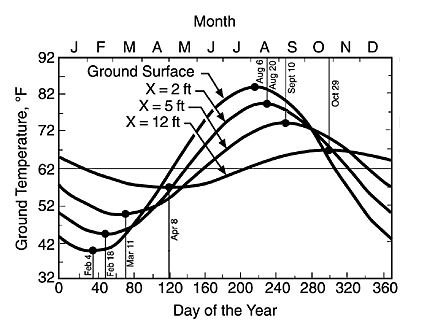

Link courtesy of https://www.reddit.com/r/science/comments/oykg1y/climate_cri...